The U.S. Food and Drug Administration has approved a new oral treatment for one of medicine's rarest and most disabling genetic diseases.
Zilurgisertib is approved for adults and children aged 12 years and older with fibrodysplasia ossificans progressiva, or FOP.
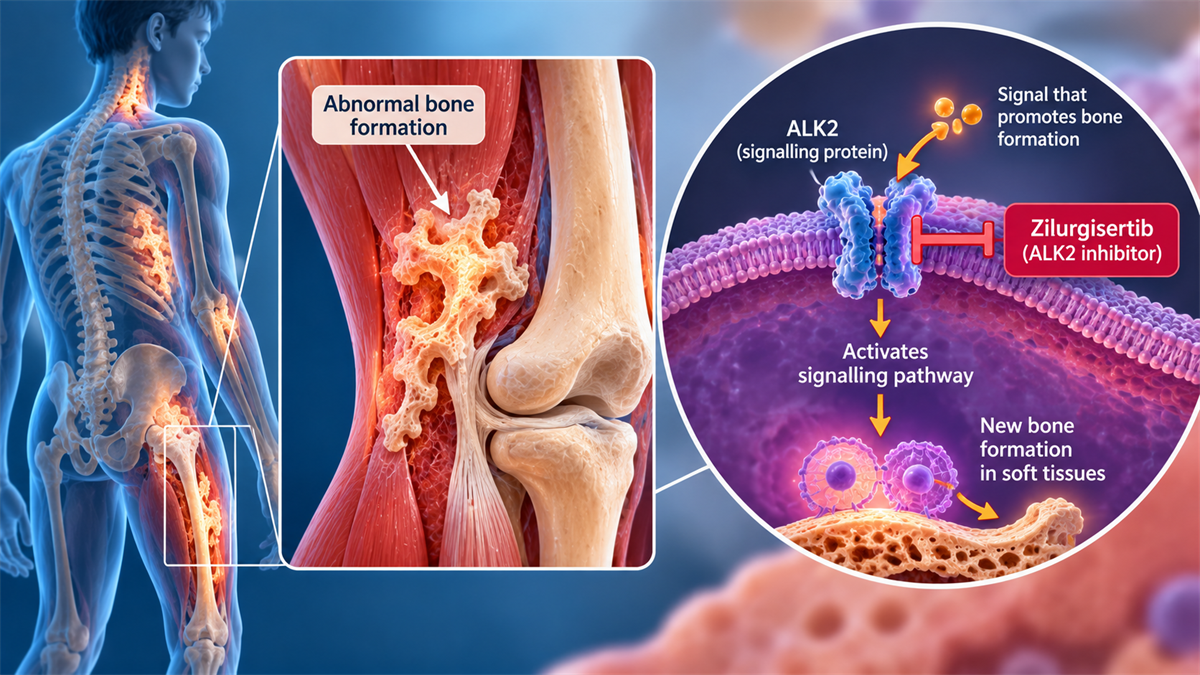
FOP causes bone to form where bone should not exist—including within muscles, tendons and ligaments.
Over time, this abnormal bone can progressively restrict movement and lead to severe disability.
Zilurgisertib works by blocking ALK2, a signalling protein that is abnormally activated in FOP.
In the randomized placebo-controlled study supporting the approval, patients receiving zilurgisertib had a reduction in the volume of new abnormal bone formation compared with patients receiving placebo.
This is an important new treatment option, but several limitations need to be clear.
Zilurgisertib does not remove established abnormal bone, and the available evidence does not show that it can reverse disability that has already developed.
It is also not the first FDA-approved treatment for FOP.
It is the third FDA-approved treatment for the condition.
What is fibrodysplasia ossificans progressiva?
Fibrodysplasia ossificans progressiva is an ultra-rare genetic disorder.
In most patients, a disease-causing change affects the ACVR1 gene, which produces a receptor involved in signals controlling bone formation.
The receptor is also known as ALK2.
In FOP, abnormal signalling causes the body to create mature bone inside soft connective tissues where bone should not normally form.
This process is called heterotopic ossification.
Muscles, tendons, ligaments and other tissues can gradually become replaced or restricted by abnormal bone.
As more joints and body regions become affected, movement can become increasingly limited.
Why is FOP particularly difficult to manage?
One of the unusual and dangerous features of FOP is that physical injury can trigger new abnormal bone formation.
Trauma to soft tissues—including some medical procedures—may provoke disease flare-ups.
This makes surgery to remove abnormal bone particularly problematic because the procedure itself can stimulate further heterotopic ossification.
For that reason, preventing new bone formation is a major treatment goal.
How does zilurgisertib work?
Zilurgisertib is an oral small-molecule inhibitor of ALK2.
ALK2 is part of the bone morphogenetic protein signalling system that helps regulate bone development.
In FOP, abnormal ACVR1/ALK2 signalling drives inappropriate bone formation in soft tissues.
By inhibiting ALK2, zilurgisertib is designed to reduce the biological signalling that promotes heterotopic ossification.
This is therefore a mechanism-targeted treatment aimed directly at a central pathway involved in the disease.
What evidence supported the approval?
The FDA evaluated zilurgisertib in the randomized, double-blind, placebo-controlled PROGRESS study.
The pivotal group included 63 patients aged 12 years and older with FOP.
Patients were randomly assigned to receive:
- zilurgisertib 100 mg once daily; or
- placebo.
The double-blind comparison lasted 24 weeks, followed by an open-label extension.
Whole-body CT imaging was used to measure new heterotopic bone formation.
What did the study find?
At week 24, the FDA reported that patients receiving zilurgisertib had an average 3.2 cubic centimetre decrease from baseline in total new heterotopic-ossification volume.
Patients receiving placebo had an average 24.6 cubic centimetre increase.
The underlying clinical programme also found fewer new heterotopic-ossification lesions and substantially lower new-lesion volume with treatment.
These imaging findings provide evidence that inhibiting ALK2 can reduce new abnormal bone formation.
Does the drug make existing abnormal bone disappear?
That should not be assumed.
The approval is specifically described as reducing the volume of total new heterotopic ossification.
The trial's central evidence comes from imaging measurements of new bone formation.
That is different from demonstrating that longstanding abnormal bone can be removed or that joints already immobilized by disease will regain normal movement.
The treatment should therefore not be described as reversing FOP.
Does this cure FOP?
No.
FOP is a lifelong genetic disorder.
Blocking an important disease pathway may reduce new abnormal bone formation while treatment is being given, but that is not the same as correcting the underlying genetic change.
The available evidence does not establish a cure.
Is this the first treatment for FOP?
No.
This point is important because describing zilurgisertib as the first FOP treatment would be inaccurate.
The FDA previously approved other treatments for FOP.
Zilurgisertib is the third FDA-approved treatment for the disease.
What distinguishes it is its mechanism as an oral ALK2 inhibitor and its approved use in patients aged 12 years and older.
What are the risks?
According to the FDA, common adverse effects include:
- headache;
- joint pain;
- upper respiratory tract infection;
- nosebleeds;
- and nausea.
The drug can also cause fetal harm based on animal data, so pregnancy-related precautions are required.
Because FOP is extremely rare and the pivotal randomized group included only 63 patients, continued monitoring will be important for understanding longer-term effectiveness and uncommon adverse effects.
Why does this approval matter?
FOP is a striking example of how understanding the molecular cause of a rare disease can lead to targeted treatment.
Researchers identified abnormal ACVR1/ALK2 signalling as a central driver of inappropriate bone formation.
Zilurgisertib was designed to inhibit that pathway.
The randomized clinical evidence and subsequent FDA approval show that this strategy can reduce new heterotopic bone formation.
For people living with FOP, preventing additional abnormal bone is clinically meaningful because accumulated heterotopic ossification contributes to progressive loss of movement.
However, the treatment's value should be described realistically.
It is an additional way to reduce new disease activity—not a method for removing all existing abnormal bone or restoring every function already lost.
What happens next?
Longer-term follow-up will help clarify how sustained ALK2 inhibition affects:
- new bone formation over years;
- disease flare activity;
- mobility and daily function;
- longer-term safety;
- and treatment earlier in life.
Studies in younger children are also important because FOP commonly begins in childhood and accumulated abnormal bone formation contributes to disability over time.
For now, the FDA approval establishes zilurgisertib as another targeted treatment option for patients aged 12 years and older with FOP.
Its significance lies in converting detailed knowledge of an abnormal molecular pathway into a treatment that measurably reduces new bone formation.