A genetic change that helps some breast cancers resist hormone treatment can now help determine whether a patient is eligible for a newly approved drug combination.
The US Food and Drug Administration has approved imlunestrant plus abemaciclib for adults with estrogen receptor-positive, HER2-negative, ESR1-mutated advanced or metastatic breast cancer whose disease has progressed following at least one line of endocrine therapy.
The approval was announced on 18 September 2026.
The development is particularly relevant to precision cancer medicine because eligibility depends on identifying an ESR1 mutation.
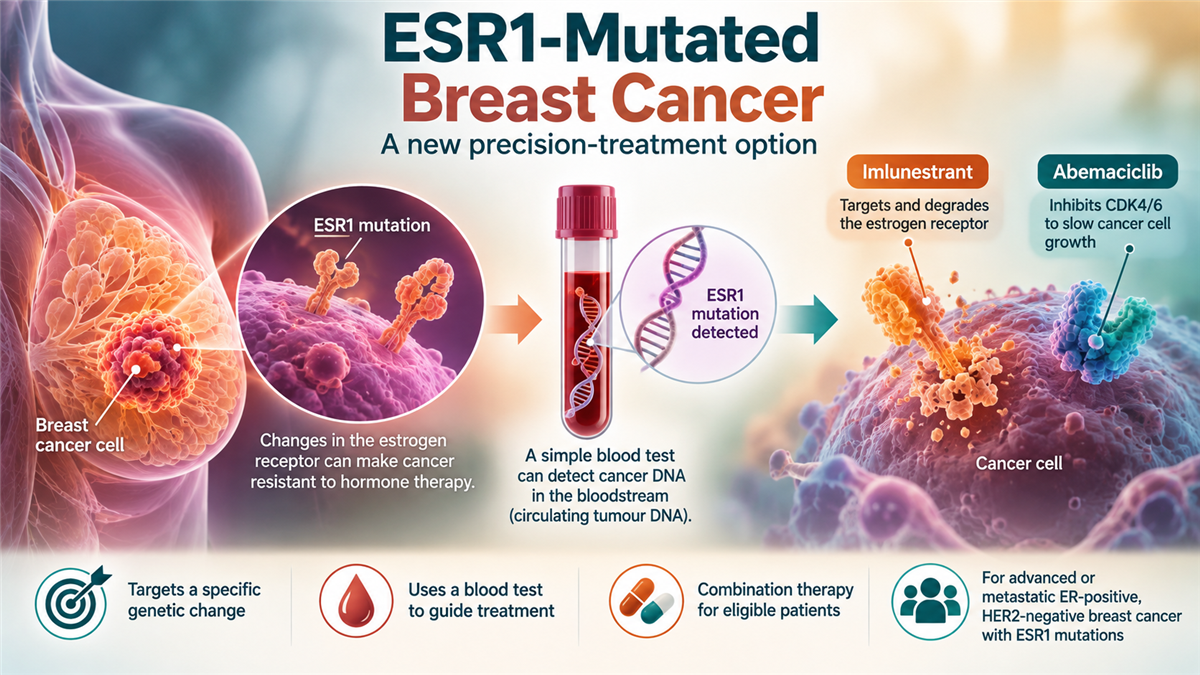
These mutations can be detected from circulating tumour DNA in blood, allowing molecular information from the cancer to guide treatment selection.
What is ESR1-mutated breast cancer?
Many breast cancers are described as estrogen receptor-positive, or ER-positive.
These cancers use estrogen-receptor signalling to help drive their growth.
Endocrine therapies interfere with that signalling and are a major part of treatment.
However, cancers can evolve under treatment pressure.
One important resistance mechanism involves mutations in ESR1, the gene that encodes the estrogen receptor.
Certain ESR1 mutations can allow the receptor to remain active even when estrogen signalling is being suppressed.
As a result, a cancer that previously responded to endocrine treatment can become resistant.
Detecting this change can therefore influence which treatment is likely to work next.
What are the two drugs?
Imlunestrant is an oral selective estrogen receptor degrader, or SERD.
It is designed to bind to and promote degradation of the estrogen receptor, reducing the signalling that helps ER-positive cancer cells grow.
Abemaciclib is a CDK4/6 inhibitor.
CDK4 and CDK6 are proteins involved in controlling progression through the cell cycle. Blocking them can slow the ability of cancer cells to divide.
The combination therefore attacks ER-positive breast cancer through two complementary mechanisms: disrupting estrogen-receptor signalling and inhibiting cell-cycle progression.
What evidence supports the combination?
The approval is supported by evidence from the randomized Phase 3 EMBER-3 trial.
The broader trial enrolled 874 patients with ER-positive, HER2-negative advanced breast cancer whose disease had recurred or progressed after endocrine treatment.
For the population relevant to the new approval, the FDA examined an exploratory subgroup of 159 patients whose cancers carried ESR1 mutations.
In this analysis, median progression-free survival was approximately:
- 11.1 months with imlunestrant plus abemaciclib
- compared with 5.5 months with imlunestrant alone.
The objective response rate was approximately:
- 35% with the combination
- compared with 15% with imlunestrant alone.
Progression-free survival measures how long people remain alive without their cancer being shown to worsen.
The results therefore indicate that the combination delayed disease progression compared with imlunestrant alone in this molecularly selected group.
Does that mean patients live longer?
That has not yet been established from the relevant evidence.
Progression-free survival is not the same as overall survival.
A treatment can delay measurable cancer progression without necessarily having been shown to extend life.
Overall-survival data were not mature enough at the relevant analysis to establish a survival benefit.
The new approval should therefore be described as demonstrating improved control of disease progression, not as proof that the combination prolongs survival.
Why is the blood test important?
Cancer treatment increasingly depends on understanding the molecular changes within an individual tumour.
Traditionally, obtaining that information often required tumour tissue.
But fragments of DNA released by cancer cells can circulate in the bloodstream.
This circulating tumour DNA, or ctDNA, can sometimes reveal important cancer mutations through a blood sample.
The FDA-authorized Guardant360 CDx companion diagnostic can identify relevant ESR1 mutations.
That creates a clinically useful sequence:
detect the resistance mutation → identify the molecularly appropriate treatment option.
This is one reason the development represents more than simply adding another breast-cancer drug.
It demonstrates how molecular testing can directly shape treatment decisions.
What are the limitations?
The first is that this treatment is intended for a specific population.
It does not apply to all breast cancers.
The approval concerns adults with:
- ER-positive disease;
- HER2-negative disease;
- advanced or metastatic cancer;
- an eligible ESR1 mutation;
- and progression following previous endocrine therapy.
The second limitation is toxicity.
Adding another active cancer medicine can improve disease control while also increasing adverse effects.
In the randomized trial, severe adverse events were substantially more common with the combination than with imlunestrant alone.
Grade 3 or higher adverse events occurred in approximately 48.6% of patients receiving the combination, compared with approximately 17.1% receiving imlunestrant alone.
This means the additional disease-control benefit needs to be considered alongside the additional treatment burden and toxicity.
Is imlunestrant itself new?
Imlunestrant is not entirely new to ESR1-mutated advanced breast cancer.
The genuinely new regulatory development is the approved combination of imlunestrant with abemaciclib for the relevant molecularly selected population.
That distinction matters because the evidence for a combination should not be confused with evidence for either medicine used independently.
Why does this development matter?
Endocrine resistance is a major challenge in advanced ER-positive breast cancer.
ESR1 mutations are one mechanism through which that resistance develops.
Instead of simply observing that endocrine treatment has stopped working, clinicians can increasingly identify a specific molecular mechanism contributing to resistance and choose treatment accordingly.
This approach is central to precision oncology.
The newly approved combination adds another option within that strategy.
But it remains treatment for advanced or metastatic disease. It should not be interpreted as a cure, and the available evidence does not yet establish improved overall survival.
What happens next?
Longer follow-up of EMBER-3 will be important.
Key questions include:
- whether the progression-free survival advantage persists;
- whether an overall-survival benefit eventually emerges;
- how treatment sequencing affects outcomes;
- which ESR1-mutated tumours derive the greatest benefit;
- and how clinicians balance improved disease control against increased toxicity.
For patients whose cancers have developed ESR1 mutations after endocrine treatment, however, the immediate development is clear:
a molecular alteration detectable in tumour-derived DNA can now help identify patients eligible for an FDA-approved combination that substantially delayed disease progression compared with imlunestrant alone in the relevant trial analysis.