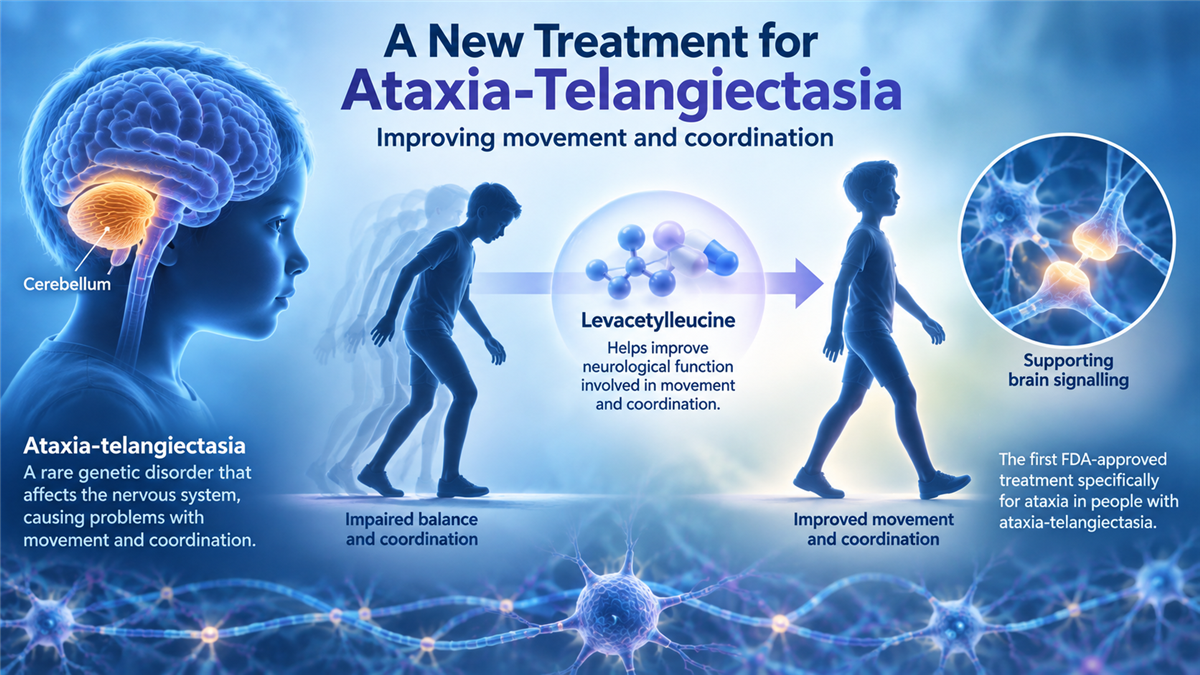
People with ataxia-telangiectasia, a rare inherited disorder that progressively affects movement and coordination, now have the first FDA-approved treatment specifically for the disease's ataxia.
The US Food and Drug Administration approved levacetylleucine on 18 September 2026 for adults and pediatric patients weighing at least 15 kg with ataxia-telangiectasia.
The regulatory decision follows a randomized Phase 3 clinical trial in which treatment improved a standardized measure of ataxia compared with placebo.
For a disease with very limited treatment options, that is important.
But the study demonstrated improvement in movement-related symptoms over a relatively short controlled period. It did not establish that the medicine slows the underlying neurodegenerative disease or prevents the other serious complications of ataxia-telangiectasia.
What is ataxia-telangiectasia?
Ataxia-telangiectasia, often shortened to A-T, is a rare genetic disorder caused by harmful variants affecting the ATM gene.
The disease affects several systems in the body.
One of its most prominent features is progressive ataxia — difficulty coordinating voluntary movement.
Children can develop problems with walking, balance, speech and fine movements. Neurological impairment generally progresses over time.
But A-T is more than a movement disorder.
The ATM gene is important in cellular responses to DNA damage. People with A-T can also have immune-system abnormalities, recurrent infections and a substantially increased susceptibility to certain cancers.
A treatment that improves ataxia therefore addresses an important part of the disease, but not necessarily all of its biological consequences.
What is levacetylleucine?
Levacetylleucine is related to the amino acid leucine.
Its precise therapeutic mechanism in ataxia-telangiectasia is not fully established.
Research suggests that it may influence neuronal metabolism and membrane function in ways that help improve the function of impaired neurological networks involved in movement.
The key question for regulators was therefore practical: does treatment produce a measurable improvement in ataxia?
The Phase 3 trial suggests that it does.
How was the treatment tested?
The pivotal study was a randomized, double-blind, placebo-controlled Phase 3 crossover trial.
It included 73 patients with genetically confirmed ataxia-telangiectasia and was conducted at ten research hospitals across six countries.
In a crossover trial, participants receive both the active treatment and placebo during different study periods, with the order determined by random assignment.
This design allows researchers to compare how the same participants perform while receiving treatment and while receiving placebo.
The controlled treatment periods lasted 12 weeks.
What did the trial find?
Researchers assessed ataxia using the Scale for the Assessment and Rating of Ataxia, commonly known as SARA.
This clinical scale measures neurological functions such as walking, standing, coordination and speech.
Lower scores represent less severe ataxia.
During treatment with levacetylleucine, the mean change in the relevant SARA measure was approximately −1.92 points, compared with approximately −0.14 points with placebo.
The estimated treatment effect was approximately −1.88 points in favour of levacetylleucine.
The difference was statistically significant.
In practical terms, participants had better measured ataxia performance during active treatment than during placebo.
Does that mean the disease itself has been slowed?
Not yet.
This is the most important distinction in interpreting the study.
Ataxia-telangiectasia is a progressive genetic disorder.
A medicine can improve neurological function or symptoms without necessarily changing the underlying long-term neurodegenerative process.
The controlled trial lasted only 12 weeks.
That is enough to demonstrate a treatment effect on ataxia, but not enough to establish that levacetylleucine:
- permanently slows neurological deterioration;
- prevents future loss of function;
- prevents immune-system complications;
- reduces cancer risk;
- or prolongs survival.
Longer-term studies and follow-up are required to answer those questions.
What about safety?
No treatment-related serious adverse events or deaths were reported during the controlled Phase 3 trial.
As with any medicine, however, adverse effects can occur.
Reported adverse events included problems such as falls, skin lacerations and urinary-tract infections.
Regulatory prescribing information also needs to be followed regarding specific safety issues, interactions and reproductive considerations.
The approval therefore does not mean that treatment is suitable for every person with A-T without individual clinical assessment.
Why is the approval important?
Until now, treatment of ataxia-telangiectasia has largely involved supportive and multidisciplinary care.
That may include physical and occupational therapy, management of respiratory and immune complications, nutritional support and surveillance for malignancy.
Levacetylleucine does not replace those aspects of care.
What changes is that clinicians now have an approved medicine specifically intended to improve ataxia, one of the central neurological manifestations of the disease.
The randomized placebo-controlled evidence also makes this development particularly notable among therapies for very rare neurological diseases, where large controlled trials can be difficult to conduct.
What questions remain?
The next major question is whether improvement seen over weeks translates into meaningful long-term preservation of neurological function.
Researchers need to determine:
- whether the treatment effect persists with prolonged use;
- whether the magnitude of benefit changes over time;
- whether starting treatment earlier changes long-term disability;
- whether particular patient groups respond better than others;
- and whether any evidence of disease modification emerges during longer follow-up.
Those questions are distinct from the evidence supporting the current approval.
For now, the evidence supports a more specific conclusion:
levacetylleucine can improve measured ataxia in people with ataxia-telangiectasia and is now the first FDA-approved treatment specifically for this manifestation of the disease.
Whether it changes the long-term course of A-T remains an open question.