The US Food and Drug Administration has approved a new treatment for spinal muscular atrophy that takes a different approach from existing medicines: instead of primarily correcting the genetic pathway that keeps motor neurons alive, it directly targets the loss of muscle function.
The drug, apitegromab-mstn, is marketed in the United States as Isembyld.
It was approved for adults and children aged 2 years and older with spinal muscular atrophy who are already receiving an SMN2-targeted treatment.
The FDA describes it as the first approved SMA therapy to directly target muscle loss.
That distinction is important because modern treatments have dramatically changed the outlook for many people with SMA, but some patients continue to experience substantial muscle weakness and limitations even after receiving therapies that address the underlying SMN protein deficiency.
What is spinal muscular atrophy?
Spinal muscular atrophy, or SMA, is a rare inherited neuromuscular disease.
It is usually caused by a problem in the SMN1 gene, which normally provides instructions for making survival motor neuron, or SMN, protein.
Motor neurons are nerve cells that carry signals from the brain and spinal cord to muscles.
When there is too little functional SMN protein, motor neurons progressively become damaged and die.
As those nerve signals are lost, muscles become weak and can shrink.
Depending on the form and severity of SMA, patients may develop problems with sitting, standing, walking, swallowing or breathing.
Before modern disease-modifying therapies became available, severe forms of SMA could cause major disability and early death.
How do existing SMA treatments work?
Humans also have a second gene called SMN2.
It can produce some functional SMN protein, but usually not enough to fully compensate for the defective SMN1 gene.
Several modern SMA treatments work by increasing the amount of useful SMN protein produced through the SMN2 pathway.
Other approaches replace the missing SMN1 genetic function.
These treatments have transformed SMA care by helping preserve motor neurons.
However, protecting motor neurons does not necessarily reverse muscle weakness that has already developed.
Some patients therefore continue to have substantial motor limitations despite receiving effective SMN-targeted treatment.
What is different about apitegromab?
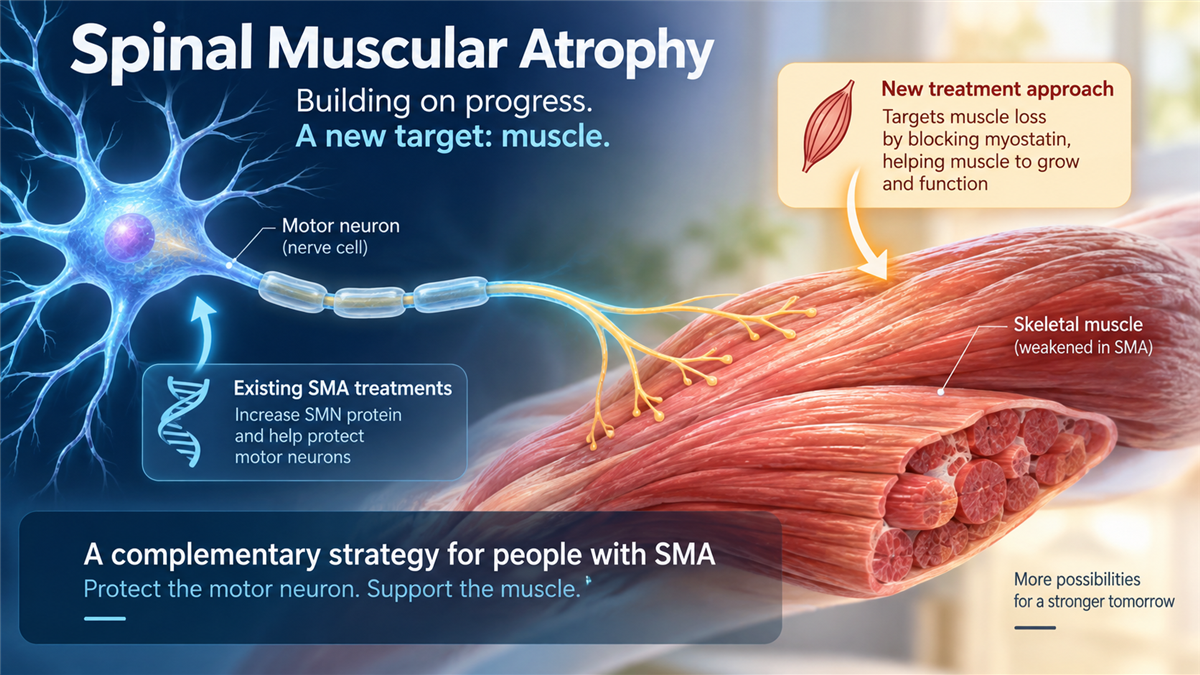
Apitegromab is intended to work at the level of skeletal muscle.
It targets a muscle-growth regulatory pathway involving myostatin.
Myostatin normally acts as a biological brake on muscle growth.
By interfering with this pathway, apitegromab is designed to increase the ability of muscle to grow and function.
This means it is not intended to replace the therapies that protect motor neurons.
Instead, it adds a second treatment strategy:
protect the motor neuron while also trying to improve the muscle that the neuron controls.
That combined approach is the central reason the approval is scientifically important.
What evidence supported the approval?
The FDA based the approval on a 52-week randomized, double-blind, placebo-controlled clinical trial involving 188 participants aged 2 to 21 years with SMA.
All participants were already receiving an approved SMN2-targeted treatment.
The patients included in the trial were unable to walk or move independently.
Participants were assigned to receive apitegromab at one of two doses or placebo by intravenous infusion approximately once every four weeks.
The main analysis focused on 156 children aged 2 to 12 years.
Researchers measured motor function using the Hammersmith Functional Motor Scale Expanded, a standardized test used in SMA.
Children receiving the approved 10 mg/kg apitegromab dose showed better motor-function outcomes at one year than those receiving placebo.
A clinically meaningful improvement was seen in 34.2% of patients receiving apitegromab compared with 13.5% receiving placebo.
In other words, patients receiving apitegromab were more than twice as likely to reach the study's threshold for meaningful motor improvement.
Does that mean apitegromab restores normal muscle function?
No.
The study showed a statistically and clinically relevant improvement in motor-function measurements.
It did not show that SMA was cured or that patients regained completely normal muscle function.
The patients also continued their existing SMN2-targeted therapies.
The results therefore support apitegromab as an add-on treatment, not as a replacement for established SMA therapies.
Who is the FDA approval for?
The US approval covers:
adults and children aged 2 years and older with SMA who are currently receiving an SMN2-targeted treatment.
This is important because the drug was studied as part of combination treatment.
Patients and families should not interpret the approval as evidence that existing SMA therapy can be stopped.
Treatment decisions require specialist neuromuscular assessment.
What are the important risks?
According to the FDA, common adverse reactions included:
- upper respiratory tract infections;
- vomiting;
- cough;
- other viral infections;
- headache;
- gastroenteritis;
- sore throat.
The FDA also reported an increased risk of fractures, including serious fractures, among patients treated with apitegromab.
The drug may also cause fetal harm and may affect reproductive function.
Longer-term monitoring will remain important as the treatment is used more widely.
Why does this approval matter?
The modern SMA treatment story has largely focused on preserving motor neurons by restoring or increasing SMN protein.
That has produced major improvements in survival and function.
But successful treatment of a neuromuscular disease may eventually require addressing more than one part of the disease process.
A therapy that acts directly on skeletal muscle introduces a complementary strategy.
For patients who remain weak despite receiving modern SMN-targeted treatment, improving muscle performance could potentially provide additional functional benefit.
The FDA approval is therefore important not simply because another SMA drug has become available, but because it introduces a new biological treatment target into established SMA care.
What we still do not know
Several questions remain.
The pivotal trial lasted around one year, so the durability of benefit over many years is not yet fully established.
The key trial population consisted mainly of children and young people with significant motor impairment.
The degree of benefit in other SMA populations may differ.
Long-term safety, fracture risk and the best way to combine muscle-targeted and neuron-targeted treatments will also need continued study.
Current evidence
FDA-approved add-on treatment supported by a randomized, double-blind, placebo-controlled trial.
Apitegromab represents the first approved SMA treatment designed to directly target muscle loss.
It should not be described as a cure, a replacement for SMN-targeted therapy or proof that established muscle damage can be fully reversed.
---