
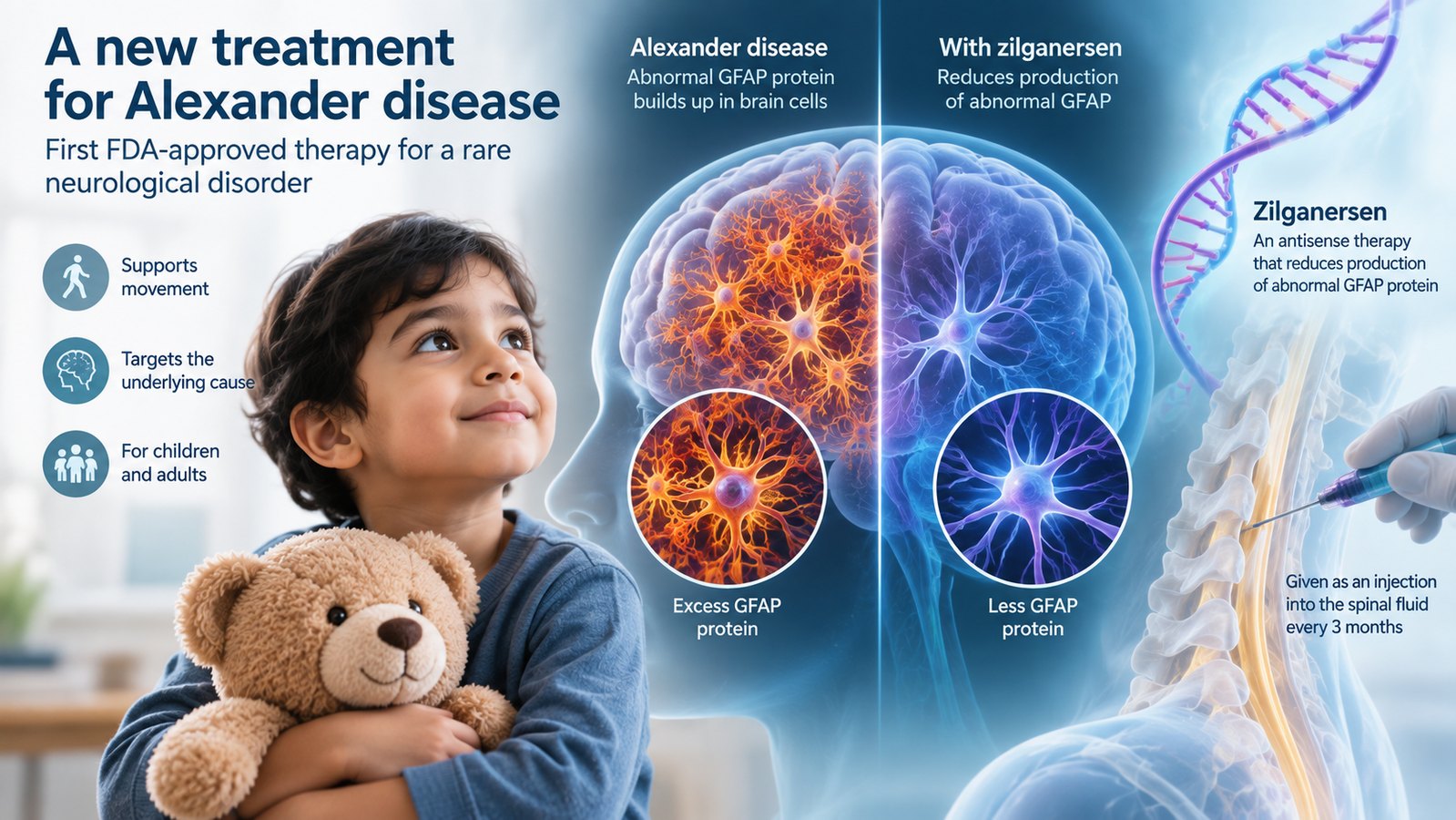
The US Food and Drug Administration has approved the first treatment for Alexander disease, an extremely rare genetic disorder that progressively damages the nervous system.
The medicine, zilganersen, is also the first treatment designed to directly address the biological cause of the disease rather than simply treating its complications.
The FDA approved the treatment on September 3 for both children and adults.
What is Alexander disease?
Alexander disease is a rare neurological disorder caused by changes in the gene responsible for producing a protein called GFAP.
GFAP normally helps support specialised cells in the brain.
In Alexander disease, abnormal GFAP accumulates inside these cells and gradually damages the nervous system.
The disease can appear at different ages and can cause problems such as developmental delay or loss of previously acquired abilities, difficulty walking, muscle weakness, seizures and other serious neurological complications.
It affects fewer than one person in a million.
Until now, there was no approved treatment capable of targeting the disease itself.
How does the new treatment work?
Zilganersen is an antisense oligonucleotide.
That technical term describes a medicine designed to interfere with the genetic instructions used by cells to manufacture a particular protein.
In this case, the treatment reduces production of GFAP.
The aim is therefore to reduce the abnormal protein accumulation believed to drive the disease.
The medicine is injected into the fluid around the spinal cord every three months by a trained healthcare professional.
What evidence led to approval?
The main clinical study included 49 children and adults aged two years or older with Alexander disease.
Patients were studied in a multicentre randomized controlled trial.
Among patients aged five years or older who already had measurable difficulty walking, those treated with zilganersen had significantly better walking speed after 61 weeks than those who did not receive the treatment.
For younger children aged two to four, researchers used broader measures of movement such as standing, walking, running and jumping.
Children receiving zilganersen improved on these measures, while children in the control group declined.
The FDA also considered information from four treated children younger than two years.
Why is this important?
Many rare genetic neurological diseases have historically had no treatment capable of altering their underlying biological cause.
Alexander disease was one of them.
This approval demonstrates how medicines designed to interfere with specific genetic messages can potentially reduce production of disease-causing proteins.
For affected families, however, the immediate significance is simpler: there is now an approved disease-targeting treatment where previously there was only supportive care.
Are there limitations?
Yes.
Alexander disease is extraordinarily rare, so the clinical trial was necessarily small.
Evidence in infants below two years of age is particularly limited.
It is also too early to know exactly how much the treatment will change long-term disability, survival and quality of life over many years.
Because the drug is injected into the spinal canal, administration also requires a specialised procedure.
Commonly reported adverse effects included vomiting, back pain, cough, headache and symptoms related to the lumbar puncture procedure.
Aseptic meningitis - inflammation around the brain and spinal cord that is not caused by a bacterial infection - has also been reported.
Does this mean Alexander disease has been cured?
No.
The treatment is designed to slow or reduce the biological process causing the disease. FDA approval does not mean the condition has become curable or that existing neurological damage will necessarily disappear.
Longer follow-up will be important to understand how treatment changes the course of the disease over many years.
Evidence so far
Regulatory approval supported by controlled clinical evidence.
The treatment has progressed beyond an experimental trial and is now FDA approved.
However, Alexander disease is extremely rare and the supporting clinical studies are necessarily much smaller than trials conducted for common diseases.