The US Food and Drug Administration has approved finerenone for adults with chronic kidney disease associated with type 1 diabetes, adding a new kidney-directed treatment option for a group that has seen relatively little therapeutic progress.
The approval is supported by the Phase 3 FINE-ONE trial, which studied 242 adults with type 1 diabetes, chronic kidney disease and significant albumin in their urine.
After six months, urinary albumin-to-creatinine ratio fell by 34% with finerenone compared with 12% with placebo.
That represented a 25% greater relative reduction with finerenone than with placebo.
The result is important because albumin leaking into the urine is an important marker of kidney damage and future kidney risk.
But there is an important limitation.
FINE-ONE was primarily designed to measure the change in urinary albumin, not whether finerenone directly prevents kidney failure, dialysis, cardiovascular events or death in people with type 1 diabetes.
The approval therefore represents an important new treatment option, but its evidence must be described precisely.
Why does type 1 diabetes damage the kidneys?
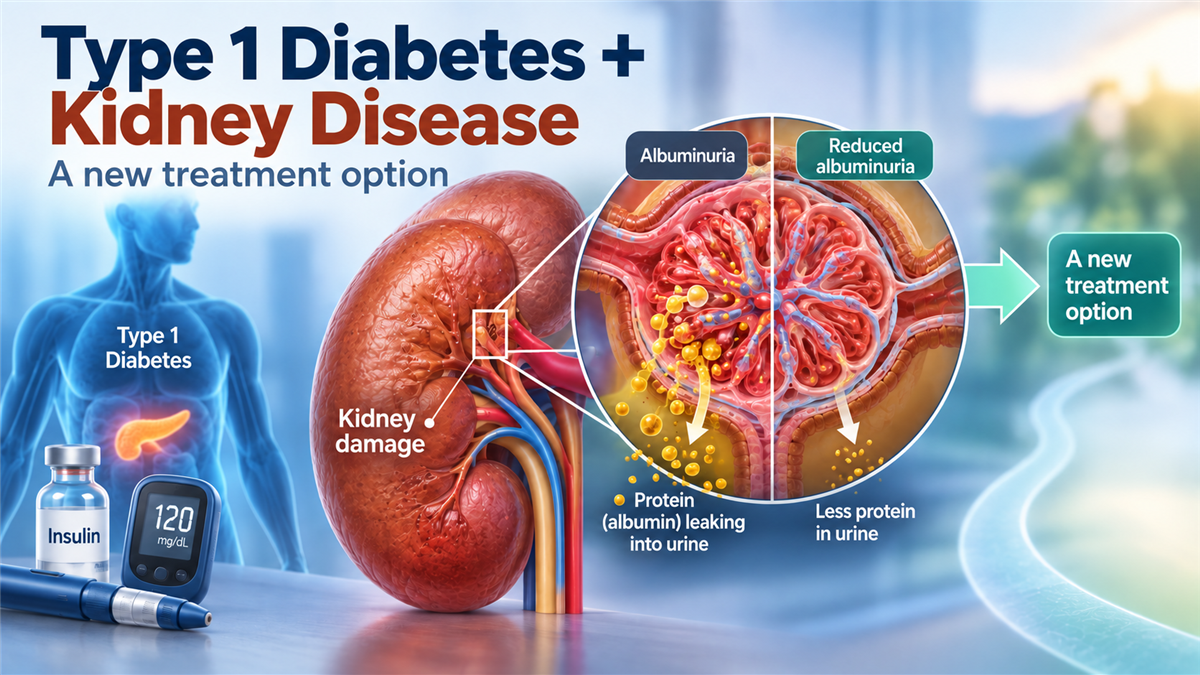
Healthy kidneys filter waste products from the blood while keeping important substances, including most proteins, inside the circulation.
Over many years, diabetes can damage the kidney's microscopic filtering structures, known as glomeruli.
As this damage develops, albumin — an important blood protein — begins to leak into the urine.
This is called albuminuria.
Kidney function can then gradually decline, sometimes eventually leading to advanced chronic kidney disease or kidney failure.
People with diabetes are therefore regularly monitored using measurements including:
- estimated glomerular filtration rate, or eGFR;
- urinary albumin-to-creatinine ratio, or UACR.
UACR measures the amount of albumin in the urine relative to creatinine and provides an important indication of kidney damage.
What is finerenone?
Finerenone is a nonsteroidal mineralocorticoid receptor antagonist.
Mineralocorticoid receptor overactivation can contribute to inflammation and fibrosis — processes that can damage the heart and kidneys.
By blocking this receptor, finerenone is designed to reduce these damaging biological pathways.
The drug has already been studied extensively in chronic kidney disease associated with type 2 diabetes.
The new development concerns people with type 1 diabetes and chronic kidney disease.
That distinction is important because evidence from type 2 diabetes cannot simply be assumed to apply equally to type 1 diabetes.
What was the FINE-ONE trial?
FINE-ONE was a randomized Phase 3 clinical trial.
It enrolled adults who had:
- type 1 diabetes;
- chronic kidney disease;
- an eGFR between 25 and less than 90 ml/min/1.73 m²;
- a urinary albumin-to-creatinine ratio between 200 and less than 5,000 mg/g.
Participants were already receiving standard kidney-protective treatment with either an ACE inhibitor or an angiotensin-receptor blocker (ARB).
A total of 242 participants were randomly assigned to receive finerenone or placebo.
Finerenone was given at 10 mg or 20 mg per day depending on kidney function.
The primary outcome was the relative change in UACR over six months.
What did the researchers find?
Among participants receiving finerenone, median UACR fell from 574.6 mg/g at baseline to 373.5 mg/g at six months.
Among participants receiving placebo, median UACR changed from 506.4 mg/g to 475.6 mg/g.
When the overall change was analysed:
UACR decreased by 34% with finerenone
compared with
12% with placebo.
This corresponded to a 25% greater relative reduction with finerenone compared with placebo.
The difference was statistically significant.
Why does reducing albumin in the urine matter?
Albuminuria is not simply an abnormal laboratory result.
Higher levels of urinary albumin are associated with greater risk of progressive kidney disease and cardiovascular complications.
Reducing albuminuria is therefore generally considered a favourable biological sign.
However, this distinction is essential:
reducing albuminuria is not the same as directly proving that a treatment prevents kidney failure.
A trial designed to prove prevention of kidney failure would generally require substantially more participants, longer follow-up and enough major kidney outcomes to compare between treatment groups.
FINE-ONE instead used UACR reduction as its primary endpoint.
The FDA approval is based on reducing UACR, which is expected to reduce the risk of chronic kidney disease progression.
Readers should therefore not interpret the trial as direct evidence that finerenone has already been proven to prevent dialysis or end-stage kidney disease in people with type 1 diabetes.
What happened to eGFR?
At six months, the change in estimated glomerular filtration rate was:
−5.6 ml/min/1.73 m² with finerenone
and
−2.7 ml/min/1.73 m² with placebo.
The difference was −2.9 ml/min/1.73 m².
Importantly, eGFR values approached baseline levels during the washout period after treatment.
Changes in eGFR after starting medicines that affect kidney haemodynamics need to be interpreted in the context of the drug's mechanism and longer-term kidney outcomes.
The six-month FINE-ONE study was not designed to establish long-term kidney-failure prevention through eGFR outcomes.
What are the important safety concerns?
The most important safety issue in FINE-ONE was hyperkalaemia, meaning an abnormally high potassium level in the blood.
Hyperkalaemia occurred in:
10.1% of participants receiving finerenone
compared with
3.3% receiving placebo.
Two participants — 1.7% of the finerenone group — stopped the drug because of hyperkalaemia.
This matters because severe hyperkalaemia can affect the heart's electrical activity.
People receiving mineralocorticoid receptor antagonists therefore require appropriate assessment of kidney function and potassium levels.
The new approval should not be interpreted as meaning finerenone is suitable for every person with type 1 diabetes and kidney disease without individual medical assessment.
Does finerenone replace ACE inhibitors or ARBs?
No.
The FINE-ONE participants were already receiving an ACE inhibitor or ARB.
Finerenone was studied as an additional treatment rather than as a replacement for this established kidney-protective therapy.
That context should be retained when interpreting the trial.
Patients should not stop existing kidney or blood-pressure medicines because of this approval.
Treatment decisions need to consider kidney function, potassium level, other medicines and the individual's overall clinical condition.
Why is this approval important?
Kidney protection in diabetes has advanced substantially in recent years, but much of the major evidence for newer kidney-protective therapies has involved people with type 2 diabetes.
People with type 1 diabetes and CKD therefore have fewer treatment options supported by direct randomized-trial evidence.
FINE-ONE specifically enrolled people with type 1 diabetes.
That makes the evidence directly relevant to this population rather than simply extrapolated from type 2 diabetes.
The FDA approval consequently adds a new treatment strategy to existing kidney-protective care for appropriately selected adults with type 1 diabetes and CKD.
What does the trial not tell us?
Several questions remain.
The trial lasted six months for its primary endpoint and included 242 participants.
It was not designed to establish whether finerenone in people with type 1 diabetes:
- prevents kidney failure;
- reduces the need for dialysis;
- prevents cardiovascular events;
- prolongs life;
- provides the same long-term kidney protection already demonstrated in some other finerenone populations.
Those questions require longer-term clinical evidence.
The increased risk of hyperkalaemia also means that appropriate patient selection and monitoring remain important.
Current evidence
FDA regulatory approval supported by a randomized Phase 3 trial involving 242 adults with type 1 diabetes and chronic kidney disease.
Finerenone produced a significantly greater reduction in urinary albumin-to-creatinine ratio than placebo over six months.
The evidence supports a new kidney-directed treatment option for appropriately selected adults with type 1 diabetes and CKD.
However, FINE-ONE did not directly establish that finerenone prevents dialysis, kidney failure, cardiovascular events or death in this population.