A new drug combination has been approved in the United States for people with advanced clear-cell kidney cancer whose disease has progressed after immunotherapy.
The U.S. Food and Drug Administration approved belzutifan plus lenvatinib for adults with advanced renal cell carcinoma containing a clear-cell component after previous treatment with a PD-1 or PD-L1 immune-checkpoint inhibitor.
The decision is based on the randomized LITESPARK-011 trial, involving 747 patients.
Compared with cabozantinib, the new combination extended the median time patients lived without their cancer progressing from 10.6 months to 14.6 months.
Tumour responses were also more frequent.
However, the final overall-survival analysis did not show a statistically significant survival advantage.
That distinction is essential when interpreting the approval.
What is clear-cell renal cell carcinoma?
Renal cell carcinoma is the most common major form of kidney cancer in adults.
Clear-cell renal cell carcinoma, or ccRCC, is its most common subtype.
The disease is called “clear-cell” because of the appearance of the cancer cells under a microscope.
The biology of clear-cell kidney cancer is strongly linked to abnormal control of how cells respond to oxygen.
This has created opportunities for targeted treatments.
What is different about belzutifan?
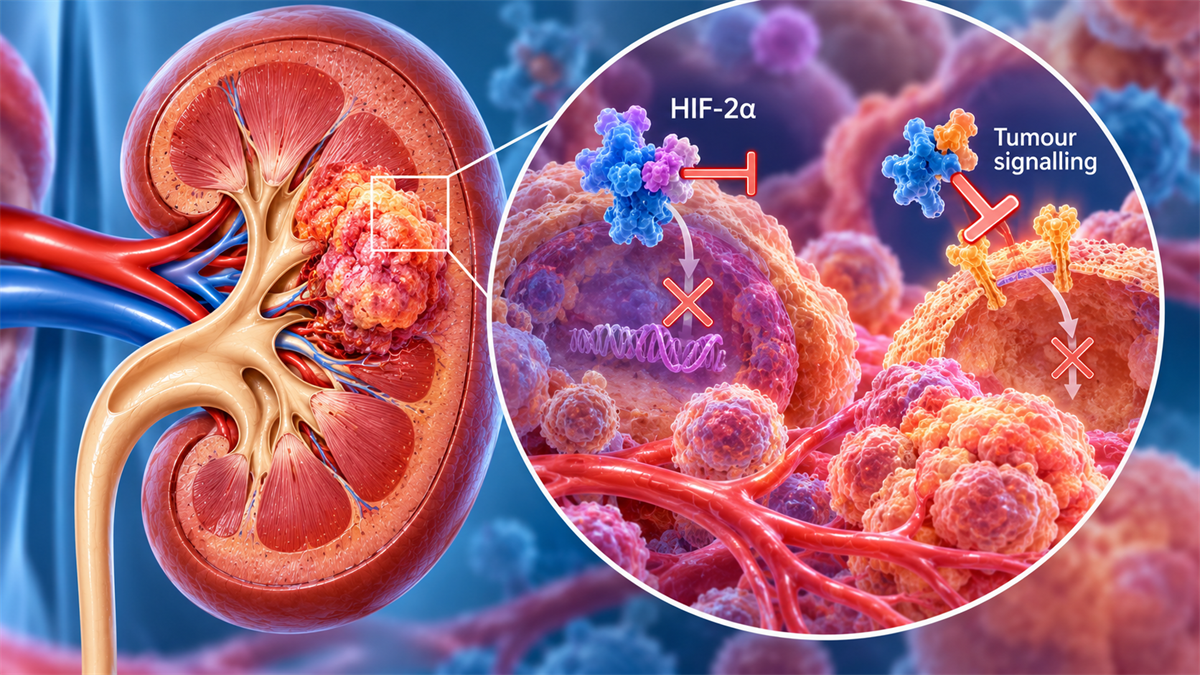
Belzutifan blocks a protein called hypoxia-inducible factor 2 alpha, usually shortened to HIF-2α.
HIF-2α helps regulate cellular responses to low oxygen.
In many clear-cell kidney cancers, molecular changes cause the HIF pathway to remain abnormally active even when it should not be.
This can promote tumour growth, formation of new blood vessels and other cancer-supporting processes.
Belzutifan is designed to inhibit this pathway.
It has already been used in other kidney-cancer settings.
The new approval concerns its combination with lenvatinib after previous checkpoint immunotherapy.
What does lenvatinib do?
Lenvatinib is a tyrosine-kinase inhibitor.
Among its effects, it interferes with signalling pathways involved in the formation of blood vessels that tumours need for growth.
Combining HIF-2α inhibition with a drug that blocks other tumour-growth and blood-vessel pathways is intended to attack the cancer through complementary mechanisms.
But whether a biological strategy actually helps patients has to be tested clinically.
That is what LITESPARK-011 evaluated.
How was the trial conducted?
LITESPARK-011 was an open-label, randomized, active-controlled trial.
It enrolled 747 patients with locally advanced or metastatic clear-cell renal cell carcinoma.
Patients had experienced disease progression during or after treatment with a PD-1 or PD-L1 inhibitor, or within six months of completing adjuvant PD-1 treatment.
Participants were randomly assigned to:
- belzutifan plus lenvatinib; or
- cabozantinib.
The major outcomes included progression-free survival and overall survival.
What did the trial find?
Median progression-free survival was:
- 14.6 months with belzutifan plus lenvatinib;
- 10.6 months with cabozantinib.
The hazard ratio was 0.74, representing a statistically significant reduction in the risk of progression or death during the analysis period.
The objective response rate—the proportion of patients whose tumours shrank by the amount required by standard trial criteria—was:
- 53% with belzutifan plus lenvatinib;
- 40% with cabozantinib.
These results show that the combination controlled cancer progression more effectively and produced more tumour responses than the comparator treatment.
Did patients live longer?
A statistically significant overall-survival advantage was not demonstrated in the final analysis.
Median overall survival was:
- 33.7 months with belzutifan plus lenvatinib;
- 28.6 months with cabozantinib.
The hazard ratio was 0.85, with a 95% confidence interval that crossed the line of no difference.
Therefore the correct conclusion is that the new combination improved progression-free survival and tumour response.
It should not be described as proven to extend overall survival compared with cabozantinib.
What are the important risks?
Both drugs can cause significant adverse effects.
Belzutifan can cause anemia and hypoxia, meaning an abnormally low level of oxygen in the body.
Its prescribing information also contains a boxed warning for embryo-fetal toxicity.
Lenvatinib has its own clinically important toxicities, including hypertension and other cardiovascular, kidney and systemic adverse effects.
Combination treatment therefore requires close medical monitoring.
The existence of an FDA approval does not mean the treatment is suitable for every patient with advanced kidney cancer.
Does this replace immunotherapy?
No.
The new indication specifically concerns patients who have already received a PD-1 or PD-L1 inhibitor.
Modern advanced kidney-cancer treatment frequently involves immune-checkpoint therapy, targeted drugs or combinations of these approaches.
The choice and sequence of treatment depend on the patient's previous therapy, tumour characteristics, overall health and other clinical factors.
Why is this development important?
Advanced clear-cell kidney cancer can become resistant to initial treatment.
When that happens, clinicians need effective therapies that work through different biological mechanisms.
HIF-2α is particularly relevant to the biology of clear-cell kidney cancer.
The LITESPARK-011 trial shows that combining HIF-2α inhibition with lenvatinib can improve disease control compared with cabozantinib in the studied post-immunotherapy population.
That makes the approval more than simply another drug being added to a list.
It represents the growing use of tumour biology to build new treatment combinations.
At the same time, the lack of a statistically significant overall-survival advantage is an important reminder that improved tumour control and longer life are related but not identical outcomes.
What is the most accurate conclusion?
For adults with advanced clear-cell renal cell carcinoma that has progressed after PD-1 or PD-L1 immunotherapy, belzutifan plus lenvatinib is now an FDA-approved treatment option.
Randomized evidence shows that the combination delays disease progression and increases tumour response compared with cabozantinib.
It has not, however, been shown in the final analysis to provide a statistically significant overall-survival advantage.
That balance—meaningful improvement in disease control together with substantial treatment risks and an unproven survival advantage—is the most accurate way to understand the new approval.