
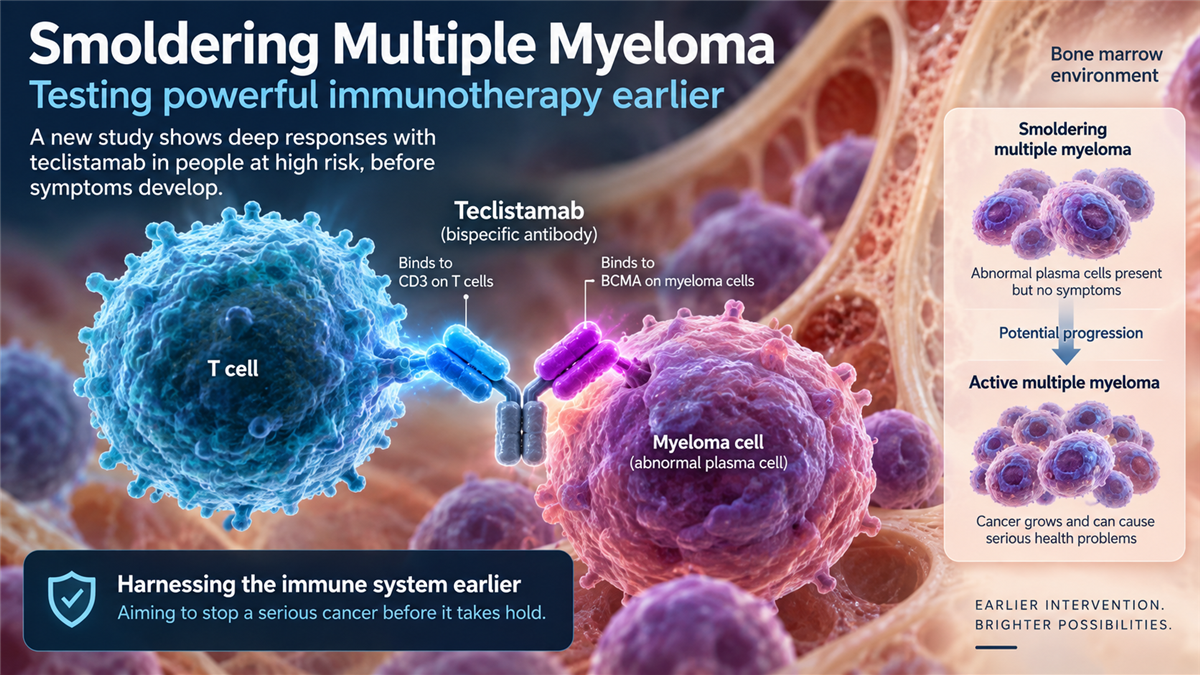
A powerful immune treatment already used for multiple myeloma has produced unusually deep responses when given before patients developed symptomatic multiple myeloma, according to a randomized Phase 2 study published in Nature Medicine.
The study tested teclistamab, a bispecific antibody that directs a patient's T cells toward abnormal plasma cells.
It was compared with lenalidomide plus dexamethasone in people with high-risk smoldering multiple myeloma.
The results were striking: 77.8% of patients treated with teclistamab achieved a complete response, compared with none in the comparison group.
But this was a small Phase 2 trial involving only 59 treated patients, and the results do not yet establish that using teclistamab at this stage will prevent symptomatic myeloma, extend life or become the preferred approach for all high-risk patients.
What is smoldering multiple myeloma?
Multiple myeloma is a cancer of plasma cells.
Plasma cells normally live in the bone marrow and produce antibodies.
In multiple myeloma, an abnormal population of plasma cells grows uncontrollably and can cause problems such as:
- anemia;
- kidney damage;
- bone destruction;
- high calcium levels;
- recurrent infections.
Before symptomatic multiple myeloma develops, some patients pass through an intermediate condition known as smoldering multiple myeloma.
These patients already have an abnormal plasma-cell population but do not yet have the organ damage or other defining features that establish active symptomatic myeloma.
Smoldering myeloma is not the same as harmless disease.
Some patients have a much higher risk than others of progressing to active multiple myeloma.
Why consider treating the disease before symptoms appear?
Historically, most patients with smoldering multiple myeloma were monitored until evidence of active myeloma developed.
But researchers have increasingly asked whether high-risk patients could benefit from treatment before the cancer becomes more biologically complex and harder to control.
There is also a theoretical advantage to using immunotherapy earlier.
At the smoldering stage:
- the number of abnormal plasma cells may be smaller;
- the cancer may have accumulated fewer genetic changes;
- the patient's immune system may still function better than in advanced disease.
That could potentially make immune-based treatment more effective.
What is teclistamab?
Teclistamab is a bispecific T-cell engager.
One part binds BCMA, a protein commonly found on myeloma plasma cells.
The other part binds CD3 on T cells.
By attaching to both cells at the same time, teclistamab brings the patient's own T cells into close contact with the abnormal plasma cells.
The T cells can then attack those cells.
Teclistamab is already used in established multiple myeloma.
The new study asks a different question:
What happens if this powerful immune treatment is used much earlier, before symptomatic multiple myeloma develops?
How was the trial conducted?
The Phase 2 study, called ImmunoPRISM, enrolled patients with high-risk smoldering multiple myeloma.
After an initial six-patient safety run-in, participants were randomly assigned in a 2:1 ratio to receive either:
- fixed-duration teclistamab; or
- lenalidomide plus dexamethasone.
As of the study analysis on 26 May 2026, 59 patients had been treated:
- 45 with teclistamab;
- 14 with lenalidomide–dexamethasone.
The main outcome was the proportion of patients achieving a complete response.
What did researchers find?
The difference between the groups was large.
A complete response occurred in:
77.8% of patients receiving teclistamab
compared with:
0% receiving lenalidomide–dexamethasone.
Researchers also looked for minimal residual disease, or MRD.
MRD testing searches for extremely small numbers of abnormal plasma cells that may remain even when routine testing shows a strong response.
In the teclistamab group, 82.2% became MRD-negative at a sensitivity of 10⁻⁵.
At a median follow-up of 24.5 months, estimated two-year progression-free survival was 92% with teclistamab and 49% with lenalidomide–dexamethasone.
Response rates, duration of response and time to progression also favored teclistamab.
Does this mean teclistamab prevents multiple myeloma?
Not yet.
This is one of the most important cautions when interpreting the trial.
A complete response or MRD-negative result shows that the detectable abnormal plasma-cell population has been greatly reduced.
It does not automatically prove that:
- symptomatic multiple myeloma will never develop;
- the disease has been permanently eradicated;
- patients will live longer;
- treatment is safer overall than monitoring or alternative strategies.
Longer follow-up will be required to answer those questions.
Why are the results scientifically important?
The study provides support for a concept sometimes described as immune interception.
Instead of waiting until an aggressive cancer is fully established, researchers try to eliminate or deeply suppress the abnormal cell population at an earlier biological stage.
Teclistamab may also work particularly well earlier because the immune system may be less impaired than it is after years of active myeloma and repeated treatment.
If larger trials eventually show lasting prevention of symptomatic disease and acceptable safety, the treatment strategy for some high-risk precursor cancers could change substantially.
What were the safety findings?
Teclistamab can activate T cells strongly.
One recognized complication is cytokine release syndrome, or CRS, in which immune activation causes fever and other inflammatory symptoms.
In this trial, CRS occurred but was reported as grade 1 or 2.
No neurotoxicity was reported.
Grade 3 infections occurred in:
- 20% of the teclistamab group;
- 21% of the lenalidomide–dexamethasone group.
No deaths occurred in either group during the reported study period.
These results are reassuring within this trial, but they do not eliminate concern about immune suppression and infection.
The risk-benefit calculation is particularly important in smoldering myeloma because patients have not yet developed symptomatic cancer.
Why can't the response percentages alone decide treatment?
The numbers are impressive, but the trial was small.
Only 45 patients received teclistamab, and only 14 received the comparison treatment.
That makes it much harder to define uncommon side effects or determine whether the results apply broadly to the diverse population of people with high-risk smoldering myeloma.
There is also an important difference between producing a deep laboratory response and proving that treatment produces a meaningful long-term advantage in survival, quality of life or prevention of organ damage.
Is smoldering myeloma already treated?
The field has changed.
High-risk smoldering myeloma is increasingly being considered for active treatment rather than observation alone in selected patients.
However, the optimal treatment, intensity and duration remain areas of active investigation.
A powerful T-cell-engaging therapy would represent a major escalation compared with traditional observation and many existing strategies.
That is why larger trials and longer follow-up are essential before the results are generalized.
Current evidence
Promising randomized Phase 2 evidence showing very deep responses with teclistamab in high-risk smoldering multiple myeloma.
The study supports further investigation of early immune therapy but does not establish that teclistamab cures smoldering myeloma or permanently prevents progression to symptomatic multiple myeloma.
---