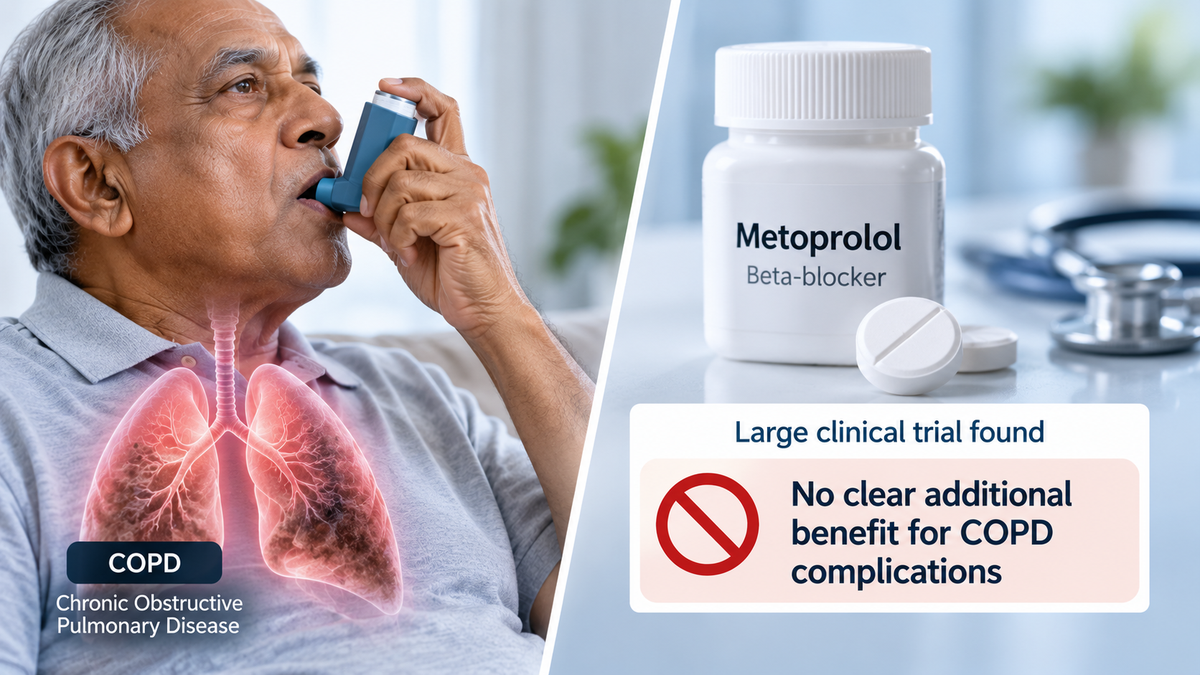
Adding the beta-blocker metoprolol to treatment did not significantly prevent major complications in people with chronic obstructive pulmonary disease (COPD) who did not have cardiovascular disease, according to a large randomized clinical trial.
The phase 4 study included 1,695 patients with COPD and followed them for one year.
Participants were randomly assigned either to receive metoprolol in addition to their usual treatment or to continue standard treatment alone.
Why was a heart medicine being tested for COPD?
Beta-blockers such as metoprolol are established treatments for several cardiovascular conditions. They can be important after some heart attacks and are widely used for conditions including heart failure and abnormal heart rhythms.
Previous observational studies had suggested that people with COPD taking beta-blockers might have fewer COPD exacerbations or other adverse outcomes.
However, observational studies can be misleading because patients who receive a medicine can differ in many ways from those who do not. Randomized clinical trials provide stronger evidence about whether the medicine itself causes the apparent benefit.
What did the trial find?
The researchers studied a combined outcome consisting of:
- COPD exacerbation
- cardiovascular event
- death
During one year, this outcome occurred in 27% of patients receiving metoprolol and 30% receiving standard care alone.
Although the number was slightly lower with metoprolol, the difference was not statistically significant.
Researchers also looked separately at COPD exacerbations, exacerbations requiring hospital admission, cardiovascular events and death. None showed a statistically significant benefit from adding metoprolol.
Why is a negative result important?
A treatment does not need to succeed for a clinical trial to change medical understanding.
If doctors begin using an additional medicine because weaker evidence suggests that it might help, a good randomized trial showing no clear benefit can prevent unnecessary treatment.
These findings argue against prescribing metoprolol solely to prevent COPD complications in people who have no cardiovascular reason to receive a beta-blocker.
Does this mean beta-blockers should not be used in people with COPD?
No. This is an essential distinction.
The trial deliberately studied people who did not have cardiovascular disease. Many people with COPD also have heart disease, and beta-blockers may be clinically important for those patients.
Someone taking a beta-blocker for heart failure, a previous heart attack, an abnormal heart rhythm or another medical indication should not interpret this study as a reason to stop treatment.
Treatment decisions should remain individualized and should be made with a qualified healthcare professional.
Were there safety differences?
Serious adverse events occurred in 9.4% of participants receiving metoprolol compared with 7.8% receiving standard care.
Non-serious adverse events occurred in 34.6% versus 29.2%, respectively.
These results need careful interpretation and do not prove that beta-blockers are generally unsafe for patients with COPD.
The central conclusion is that adding metoprolol for patients without cardiovascular disease did not demonstrate the expected preventive benefit.
What are the study's limitations?
The study was randomized and relatively large, which are major strengths.
However, it was open-label, meaning patients and treating clinicians knew whether metoprolol was being used. It also studied metoprolol specifically, so the findings should not automatically be assumed to apply identically to every beta-blocker or to patients who have established cardiovascular indications.
Evidence so far
Strong randomized evidence against routinely adding metoprolol solely for COPD prevention in people without cardiovascular disease.
This phase 4 randomized trial provides stronger evidence than previous observational studies. It does not argue against using beta-blockers when patients have an established cardiovascular reason to receive them.