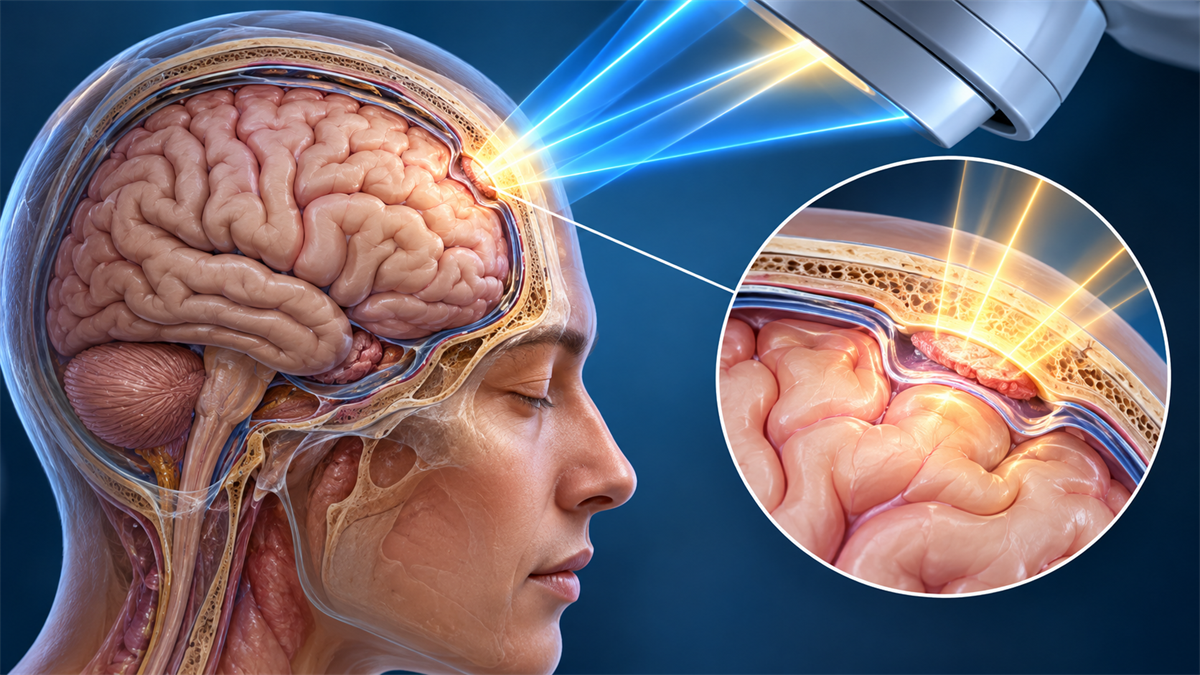
A major international randomized trial has provided the strongest evidence yet for what should happen after surgeons completely remove a type of brain tumour called a WHO grade 2 atypical meningioma.
For years, doctors and patients have faced a difficult choice.
Should radiotherapy be given soon after surgery to reduce the chance that the tumour returns?
Or should the patient avoid immediate radiotherapy and instead undergo regular brain scans, with further treatment used only if the tumour comes back?
The ROAM/EORTC-1308 trial directly compared these two approaches.
After about five years of follow-up, tumour recurrence occurred in 14% of patients assigned to radiotherapy compared with 30% assigned to observation.
Five-year disease-free survival was also higher with radiotherapy.
The findings provide the first randomized evidence that postoperative radiotherapy can substantially reduce recurrence after complete removal of an atypical meningioma.
However, the result does not mean that every patient should automatically receive radiotherapy.
Radiotherapy involves weeks of treatment and can cause short- and long-term side effects. The decision therefore remains one that should consider the individual patient's tumour, health, priorities and the possible benefits and harms of treatment.
What is an atypical meningioma?
A meningioma is a tumour arising from the membranes that surround the brain and spinal cord rather than from the brain tissue itself.
Many meningiomas grow slowly and behave relatively benignly.
WHO grade 2 meningiomas, often called atypical meningiomas, behave more aggressively than grade 1 tumours and have a greater chance of returning after treatment.
Surgery is usually an important part of treatment when the tumour can be safely removed.
Even after surgeons appear to have completely removed a grade 2 meningioma, however, microscopic tumour cells may remain.
That creates a difficult question about whether additional treatment should be given immediately.
Why has radiotherapy after surgery been controversial?
Radiotherapy can destroy remaining tumour cells that are too small to see on a scan or during surgery.
This gives a strong biological reason to use it after tumour removal.
But radiotherapy to the brain is not a trivial treatment.
It can cause short-term effects such as tiredness and skin or hair changes in the treated area, while delayed effects on healthy brain tissue and neurological function are also important considerations.
If surgery has apparently removed the entire tumour, some patients may never experience a recurrence even without radiotherapy.
Giving radiotherapy to everyone could therefore expose some people to treatment they might not otherwise have needed.
Until now, much of the evidence guiding this decision came from non-randomized studies.
The ROAM trial was designed to answer the question more reliably.
How was the trial conducted?
ROAM/EORTC-1308 was an international, multicentre, open-label, randomized Phase 3 clinical trial.
It enrolled patients whose newly diagnosed WHO grade 2 atypical meningioma had been completely surgically removed.
A total of 157 patients were randomly assigned to one of two strategies:
- postoperative radiotherapy; or
- observation with follow-up.
The study was conducted across 58 hospitals in 11 countries.
Patients assigned to radiotherapy received 60 Gy in 30 fractions, meaning the total radiation dose was divided into 30 treatment sessions.
The central question was whether giving radiotherapy immediately after surgery would reduce the chance of the tumour returning.
What did the researchers find?
After a median follow-up of approximately five years, 35 patients had experienced tumour recurrence.
Recurrence occurred in:
- 11 of 78 patients — 14% — assigned to radiotherapy;
- 24 of 79 patients — 30% — assigned to observation.
Five-year disease-free survival was approximately:
- 79.9% with radiotherapy;
- 64.3% with observation.
In simple terms, patients receiving radiotherapy were substantially less likely to have their tumour return during the follow-up period.
This is important because recurrence can lead to additional surgery, radiotherapy or other treatment and can create considerable medical and psychological burden.
Does this mean radiotherapy helps patients live longer?
That conclusion should not be made from these results.
The major demonstrated benefit is a reduction in tumour recurrence and improved disease-free survival.
Preventing or delaying recurrence is clinically important, but it is not the same as proving that treatment extends overall survival.
Longer follow-up will help determine the full long-term consequences of the two strategies.
What about the side effects of radiotherapy?
This is one of the most important parts of the treatment decision.
In the trial, serious radiation-related toxicity was uncommon.
Researchers also reported no meaningful difference between the groups in health-related quality of life or neurocognitive function during the reported follow-up.
That is reassuring.
However, radiation can produce delayed effects that may emerge over many years.
A patient who may otherwise live for decades after treatment may reasonably place considerable importance on such long-term risks.
Therefore the trial does not eliminate the need for individualized decision-making.
Instead, it provides much stronger evidence about the benefit side of that decision.
Why is this study important?
Some important medical advances come from entirely new drugs or technologies.
Others come from finally answering an old clinical question with a well-designed randomized trial.
ROAM belongs to the second group.
Doctors already had access to surgery, radiotherapy and MRI surveillance.
What was missing was high-quality randomized evidence showing which postoperative strategy better prevents recurrence after complete removal of an atypical meningioma.
The new trial substantially reduces that uncertainty.
Does this apply to every meningioma?
No.
The findings should not be generalized to every person diagnosed with a meningioma.
The trial addressed a specific clinical situation:
a newly diagnosed WHO grade 2 atypical meningioma that had been completely surgically resected.
Patients with grade 1 tumours, grade 3 tumours, incompletely removed tumours or other clinical circumstances may require different management.
What happens next?
The findings are likely to influence discussions between neurosurgeons, radiation oncologists and patients and may inform future clinical guidelines.
Longer follow-up remains important, particularly for understanding late radiation effects and whether the recurrence advantage persists beyond the first several years.
The central message, however, is now much clearer:
For patients with a completely removed WHO grade 2 atypical meningioma, immediate postoperative radiotherapy substantially reduces the risk of the tumour returning compared with observation alone.
That does not make radiotherapy an automatic choice for every patient, but it gives patients and clinicians the randomized evidence that has long been missing from this decision.