An experimental treatment designed to target the genetic cause of a rare and often aggressive form of amyotrophic lateral sclerosis has succeeded in a Phase 3 clinical trial.
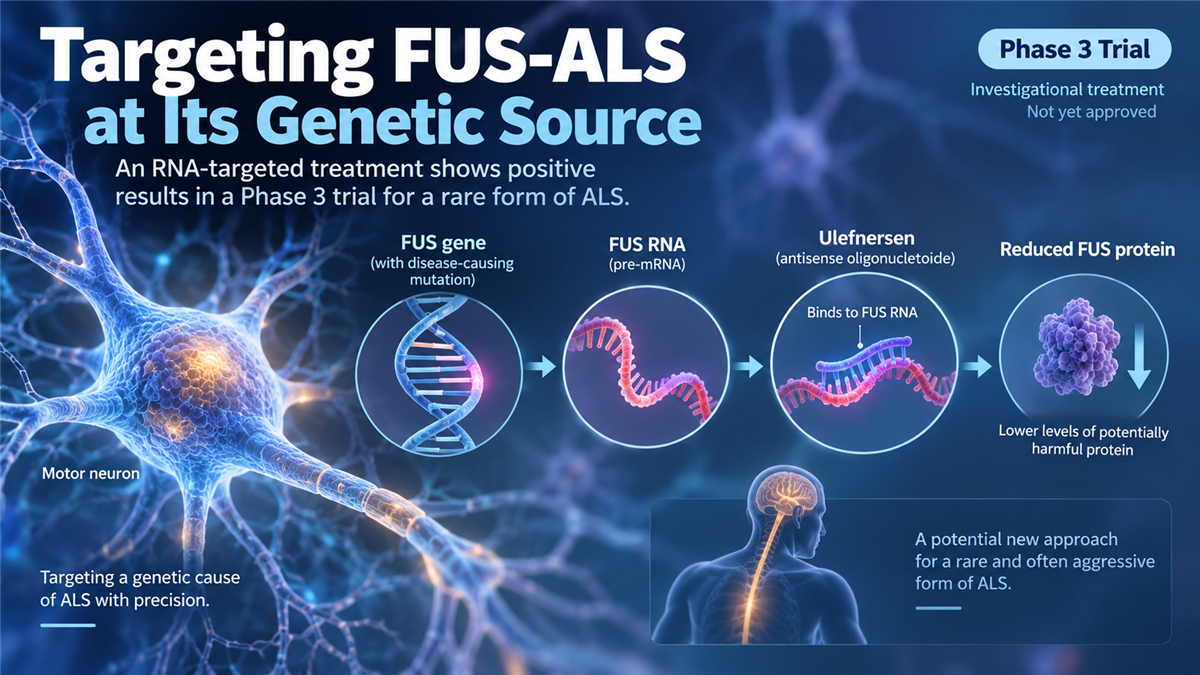
The treatment, called ulefnersen, is being developed for people with ALS caused by disease-causing variants in the FUS gene.
On 22 September 2026, developers Otsuka and Ionis announced that the Phase 3 FUSION trial met its primary endpoint, showing a statistically significant result favouring ulefnersen over placebo on a measure combining neurological function and major disease outcomes.
It is an important result for precision treatment of genetic ALS.
However, the evidence currently available consists of topline Phase 3 results released by the developers.
Detailed effect sizes and complete safety results have not yet been presented in a full peer-reviewed Phase 3 publication.
Ulefnersen also remains investigational and is not yet an approved treatment.
What is FUS-ALS?
Amyotrophic lateral sclerosis, or ALS, is a progressive neurological disease in which motor neurons — the nerve cells controlling voluntary muscles — progressively stop functioning.
As the disease advances, people can lose the ability to move, speak, swallow and breathe independently.
ALS can have many different biological causes.
In a small proportion of patients, the disease is caused by pathogenic changes in a gene called FUS, short for fused in sarcoma.
FUS-ALS is rare overall, but FUS mutations are disproportionately represented among people who develop ALS at a very young age, including juvenile forms of the disease.
Some forms can progress extremely rapidly.
What is ulefnersen?
Ulefnersen is an antisense oligonucleotide, often shortened to ASO.
An antisense medicine is a short synthetic strand designed to bind to a specific RNA molecule inside cells.
Genes normally provide instructions that are copied into RNA before proteins are produced.
Ulefnersen targets FUS pre-mRNA.
By binding to this RNA, the treatment is designed to reduce production of both mutant and normal FUS protein.
The aim is to lower the amount of harmful FUS protein involved in motor-neuron degeneration.
This makes ulefnersen a precision treatment directed at a specific molecular cause of ALS rather than a general treatment for all forms of the disease.
How was the Phase 3 trial designed?
FUSION is an international, randomized, double-blind, placebo-controlled study.
Participants were assigned to receive intrathecal ulefnersen — treatment delivered into the fluid surrounding the spinal cord — or placebo during the double-blind phase.
The primary analysis extended through day 505, approximately 72 weeks.
Rather than relying on only one measurement, the primary endpoint used a joint-rank analysis combining several important outcomes:
- time to death or permanent ventilation
- time to rescue treatment
- and change in the ALS Functional Rating Scale-Revised, or ALSFRS-R.
ALSFRS-R measures a person's ability to perform functions such as speaking, swallowing, walking and breathing.
What did the trial find?
According to the topline results released by the developers, ulefnersen produced a statistically significant improvement compared with placebo on the primary endpoint.
The reported p-value was:
p = 0.0005
Important secondary outcomes also favoured treatment.
These included changes in serum neurofilament light chain, or NfL, a biomarker associated with nerve-cell injury, and a composite outcome involving death, permanent ventilation, rescue treatment or withdrawal because of disease progression.
The developers reported that most adverse events were mild or moderate.
These findings support the possibility that reducing FUS protein can alter the progression of FUS-ALS.
But the current public data do not yet provide the complete picture.
Why isn't the p-value enough?
A small p-value tells researchers that the observed difference would be unlikely to occur by chance under the statistical assumptions of the analysis.
It does not tell readers how large the clinical benefit was.
To understand the practical importance of ulefnersen, clinicians will need detailed results showing the magnitude of differences in function, survival-related outcomes, biomarker changes and adverse events.
Those detailed Phase 3 results have not yet been fully presented or peer-reviewed.
This is why the current finding can appropriately be described as a positive Phase 3 topline result, but not yet as definitive proof of the size of long-term clinical benefit.
Why is this scientifically important?
Genetic ALS provides an opportunity to target a specific biological cause of disease.
Another antisense treatment, tofersen, targets ALS associated with mutations in the SOD1 gene.
Ulefnersen extends the same broad concept to FUS-ALS: identify the disease-causing genetic pathway and design an RNA-targeted treatment specifically against it.
The FUSION result therefore supports a broader strategy in neurological medicine in which ALS is increasingly treated not as one biologically identical disease but as a group of disorders that may require different molecular treatments.
Is ulefnersen approved?
No.
Ulefnersen remains an investigational treatment.
The developers have said they plan to discuss the Phase 3 findings with the US FDA and other regulatory authorities and explore potential expedited regulatory pathways.
A successful Phase 3 trial does not itself constitute regulatory approval.
Regulators will need to review the complete efficacy, safety, manufacturing and other evidence before deciding whether the treatment should be approved.
Does this mean FUS-ALS can now be cured?
No.
The current result should not be described as a cure.
The topline evidence indicates that ulefnersen performed significantly better than placebo on a combined measure involving function and major disease outcomes.
That is potentially very important.
But it does not establish that treatment permanently stops ALS, restores all neurological function or normalizes life expectancy.
Full results and longer-term follow-up are needed.
What happens next?
The next important steps are:
- presentation of detailed Phase 3 results
- publication in a peer-reviewed journal
- fuller analysis of the magnitude of functional benefit
- detailed safety evaluation
- longer-term follow-up
- and regulatory review.
If the detailed evidence supports the topline announcement, ulefnersen could become an important example of genetically targeted treatment for a devastating neurological disease.
For now, the most accurate conclusion is:
a Phase 3 randomized trial has provided positive placebo-controlled evidence that targeting FUS RNA may alter the course of FUS-associated ALS — but the treatment remains investigational and the complete Phase 3 evidence is still awaited.