
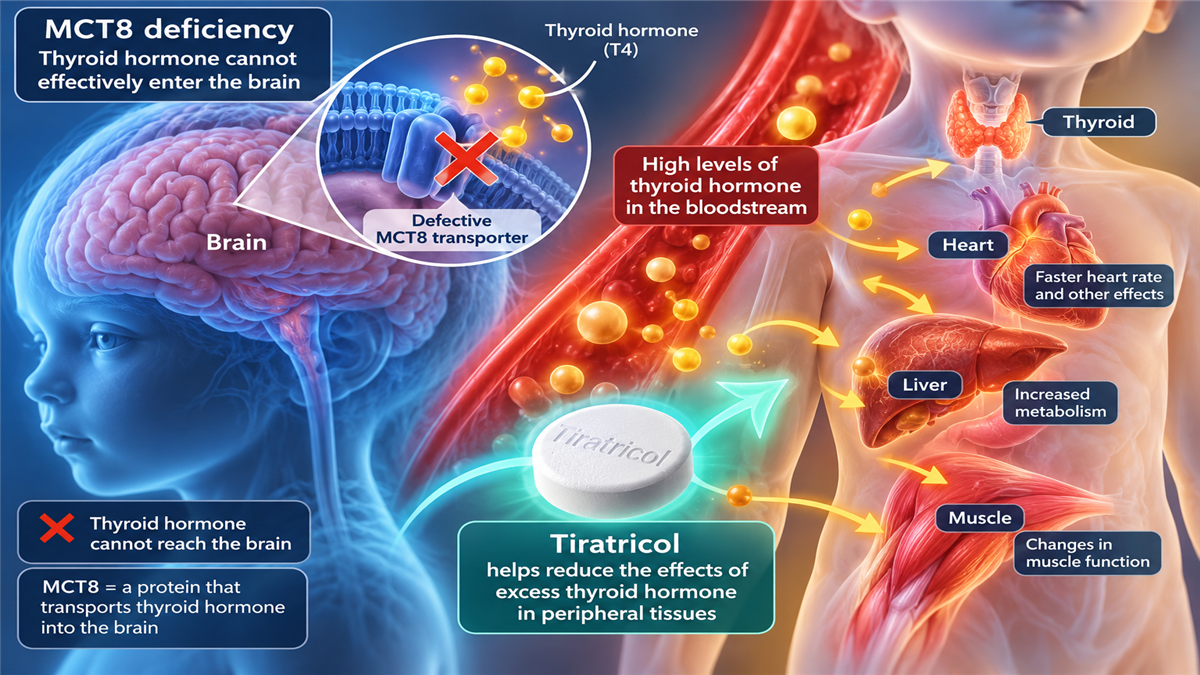
The US Food and Drug Administration has approved Emcitate (tiratricol) to treat peripheral thyrotoxicosis in people with MCT8 deficiency, also known as Allan-Herndon-Dudley syndrome. It is the first FDA-approved treatment for this rare genetic disorder.
MCT8 is a transporter protein that helps thyroid hormone enter cells, including cells in the developing brain. In MCT8 deficiency, a change in the SLC16A2 gene prevents the transporter from working properly. The brain receives too little thyroid hormone while excessive thyroid hormone activity develops in other parts of the body.
That excess activity outside the brain is called peripheral thyrotoxicosis. It can place chronic stress on the heart and metabolism, contributing to a rapid heart rate, raised blood pressure, poor weight gain and other problems.
Tiratricol is a thyroid-hormone-receptor agonist that can enter cells without relying on the faulty MCT8 transporter. In the studies reviewed by the FDA, treatment lowered excess circulating thyroid hormone and improved related measures such as heart rate and systolic blood pressure.
Emcitate is taken once daily as a liquid suspension, either by mouth or through a feeding tube. The most commonly reported side effects included diarrhoea, vomiting, rash and excessive sweating. The FDA also advises that it should not be used together with another thyroid medicine unless directed by the treating team.
The scope of the approval is important. Tiratricol treats the peripheral thyrotoxicosis associated with MCT8 deficiency. It does not repair the underlying genetic change, and the available evidence does not show that it reverses established severe neurological impairment or normalises brain development.
The approval therefore offers a meaningful way to control the damaging effects of excess thyroid hormone in the rest of the body, while multidisciplinary care remains necessary for the neurological, nutritional and developmental effects of the condition.