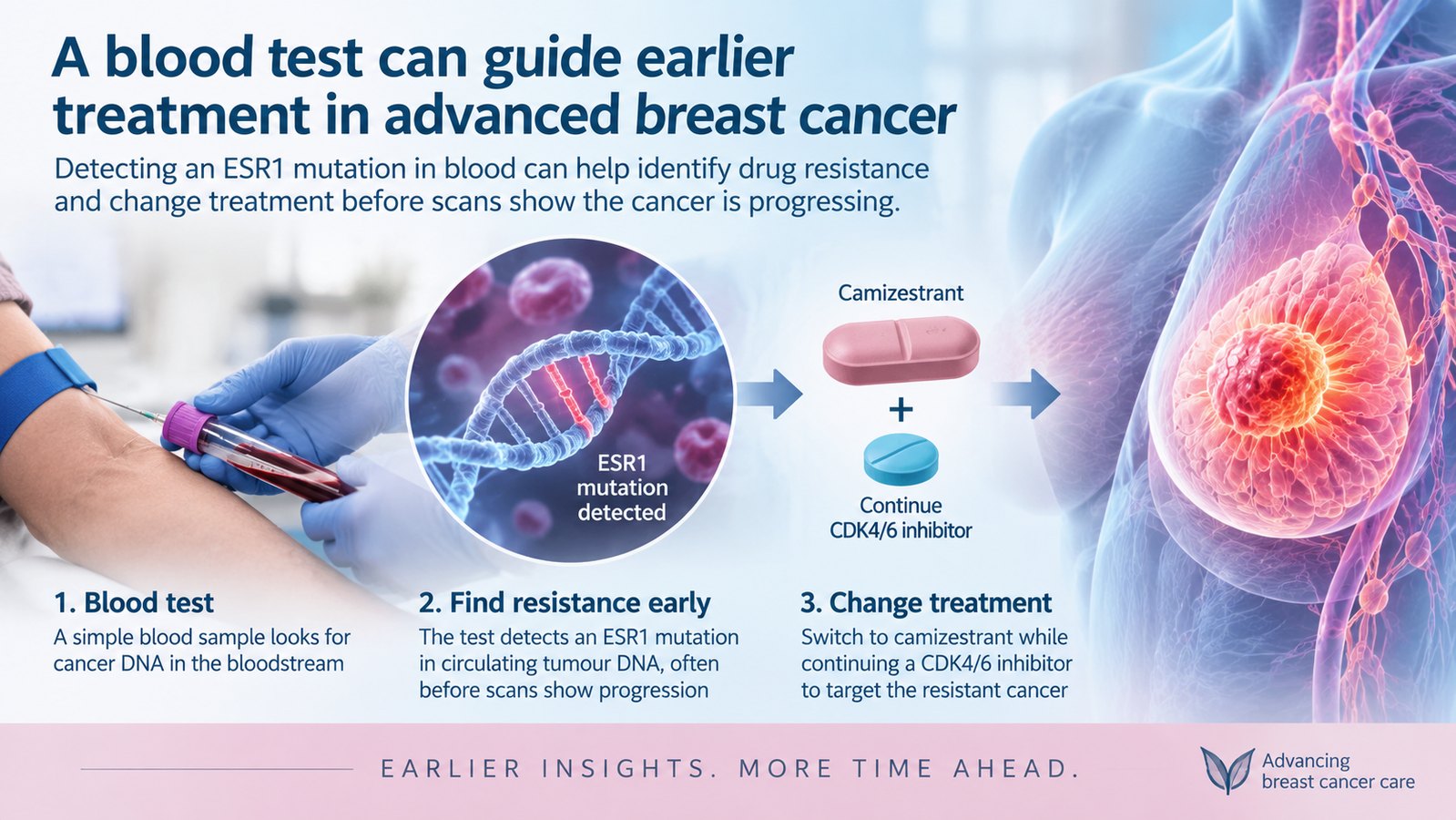
A blood test that detects signs of treatment resistance in cancer DNA can now be used to trigger an earlier change in treatment for some people with advanced breast cancer.
The US Food and Drug Administration granted accelerated approval on September 4 to camizestrant combined with a CDK4/6 inhibitor for selected patients with advanced hormone-sensitive breast cancer whose tumours develop a particular resistance mutation called ESR1.
What makes the development unusual is not simply the approval of another breast-cancer medicine.
The treatment can be changed before ordinary scans show that the cancer has progressed.
How can a blood test detect cancer resistance?
Cancer cells can release small fragments of their DNA into the bloodstream.
This is known as circulating tumour DNA, or ctDNA.
A blood sample can sometimes detect genetic changes in this DNA long before a growing tumour becomes obvious on a scan.
One such change is an ESR1 mutation.
These mutations can develop while patients are receiving aromatase inhibitors, a commonly used form of hormone treatment for certain breast cancers.
Once the mutation develops, the cancer can become resistant to that treatment.
What is different about this new approach?
Traditionally, treatment for advanced cancer is often changed after scans or symptoms show that the disease is progressing.
In this approach, doctors repeatedly test the blood for an ESR1 mutation.
If the mutation appears while the patient is still clinically stable and scans have not yet shown progression, the hormone treatment can be switched to camizestrant while the existing CDK4/6 inhibitor is continued.
The idea is to act against developing drug resistance before it produces visible tumour progression.
What did the trial show?
The FDA decision was based on the SERENA-6 trial, involving 315 patients with advanced estrogen-receptor-positive, HER2-negative breast cancer.
All had been receiving an aromatase inhibitor together with a CDK4/6 inhibitor and had no evidence of cancer progression when the ESR1 mutation was detected in their blood.
Patients were then randomly assigned either to switch the hormone component to camizestrant or to continue their existing aromatase inhibitor.
The median time before the cancer progressed was approximately 16 months in patients who switched to camizestrant compared with 9.2 months in those who continued the previous hormone treatment.
That is a substantial difference in the time patients remained free from disease progression.
Why does this matter?
This represents an important development in precision medicine.
Instead of waiting until a cancer visibly changes on imaging, doctors may increasingly be able to detect molecular changes in the tumour through the blood and adapt treatment earlier.
The FDA describes the approval as the first cancer-treatment approval guided by detection of a resistance mutation in blood before imaging shows disease progression.
If this strategy ultimately improves major patient outcomes, it could help change how some advanced cancers are monitored.
Is longer survival already proven?
No.
This is a particularly important limitation.
The FDA granted accelerated approval, which allows earlier approval on the basis of evidence that is strongly suggestive of clinical benefit while further evidence continues to be collected.
The study clearly showed longer progression-free survival.
However, the overall-survival results are not yet mature, meaning researchers do not yet know whether making this earlier treatment change ultimately helps patients live longer.
Continued approval may depend on confirmatory evidence.
Are there safety concerns?
Yes.
Camizestrant can affect the electrical activity of the heart.
The prescribing information includes a boxed warning concerning the risk of abnormal heart rhythms when the medicine is used together with other drugs that can prolong the heart's QT interval.
Warnings also include slow heart rate and risk to a developing fetus.
Patients therefore require appropriate medical assessment and monitoring.
Who does this apply to?
This approach does not apply to every person with breast cancer.
The approval concerns adults with locally advanced or metastatic HR-positive, HER2-negative breast cancer who are already receiving a particular combination of hormone therapy and a CDK4/6 inhibitor and who develop an ESR1 mutation detectable using an FDA-authorised blood test.
Evidence so far
Strong randomized evidence for delaying progression, but overall clinical benefit is still being confirmed.
The treatment strategy was tested in a randomized, double-blind trial involving 315 patients and substantially prolonged progression-free survival.
However, the FDA approval is accelerated rather than traditional approval, and whether the strategy improves overall survival remains unanswered.