Pancreatic cancer is one of the most difficult major cancers to detect early. By the time symptoms appear, the disease has often progressed beyond the stage at which surgery offers the best chance of long-term survival.
A newly published international study suggests that a blood test could eventually help change that.
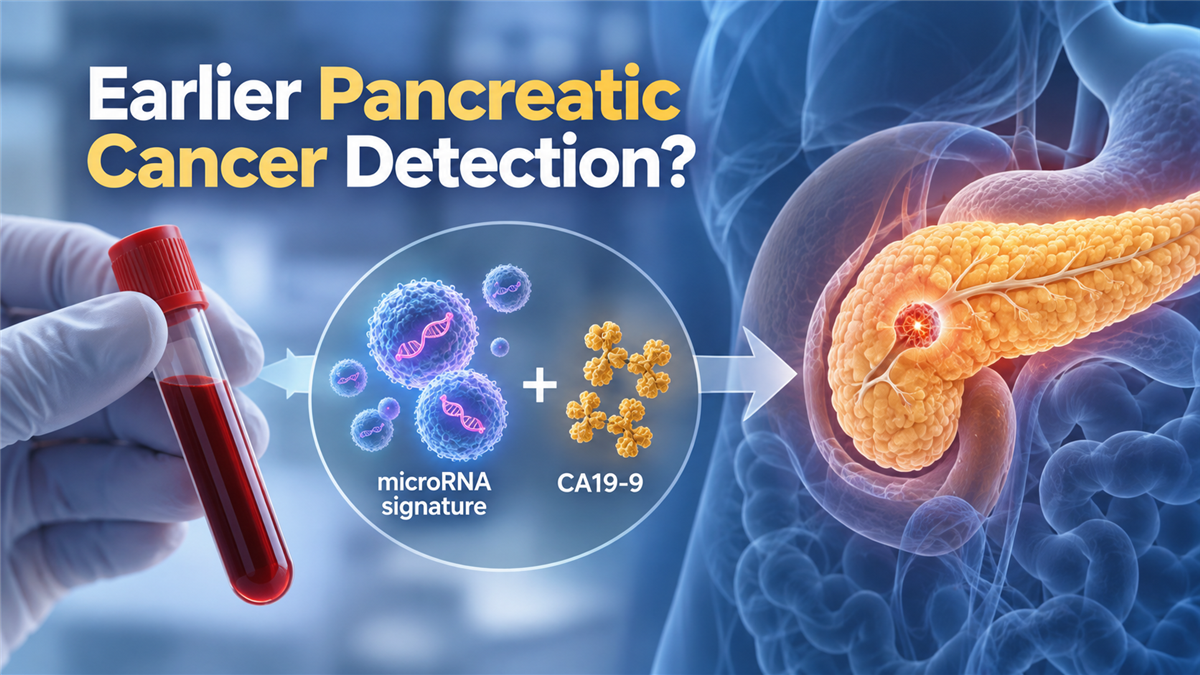
Researchers developed a blood-based biomarker called PANXEON, which combines a signature of small molecules called microRNAs with an existing blood marker known as CA19-9.
In a prospective multicentre study involving 1,785 people from four countries, the combined test detected 86.8% of stage I–II pancreatic ductal adenocarcinomas in the testing cohort.
That is an encouraging result.
But it does not mean that a reliable pancreatic-cancer screening blood test is now available for routine use.
The study evaluated how accurately the biomarker distinguished people with and without pancreatic cancer. It did not test whether using PANXEON to screen the general population reduces deaths from pancreatic cancer.
The researchers themselves conclude that larger prospective studies are needed.
Why is pancreatic cancer so difficult to detect early?
The most common form of pancreatic cancer is pancreatic ductal adenocarcinoma, often abbreviated as PDAC.
One reason this cancer has such poor outcomes is that early disease may cause few or no obvious symptoms.
The pancreas is located deep within the abdomen, so small tumours cannot usually be detected through routine physical examination.
Symptoms such as jaundice, abdominal or back pain, weight loss and digestive problems may appear only after the cancer has grown or spread.
This makes early detection especially important.
Surgery can potentially remove localized pancreatic cancer, but many patients are diagnosed only after surgery is no longer possible.
Researchers have therefore spent years looking for blood-based signals that could identify pancreatic cancer at an earlier stage.
What is PANXEON?
PANXEON stands for:
PANcreatic cancer eXosome Early detectiON.
The approach uses information from small regulatory molecules called microRNAs, or miRNAs.
MicroRNAs help regulate how genes are used inside cells.
Cancer can alter the pattern of microRNAs released into the bloodstream.
The researchers identified a signature involving 10 microRNAs associated with pancreatic cancer.
They then combined that signature with another marker already familiar in pancreatic-cancer care: CA19-9.
CA19-9 can be elevated in pancreatic cancer, but it is not accurate enough by itself to serve as a general screening test.
It can also be increased in some non-cancerous conditions, and some people do not produce useful levels of the marker.
The researchers therefore tested whether combining CA19-9 with the new microRNA signature could provide better diagnostic performance.
How was the study performed?
The study was an international, multicentre, observational prospective biomarker study.
It involved 1,785 individuals with and without pancreatic ductal adenocarcinoma across four countries.
Researchers developed and validated the microRNA signature and then evaluated its performance in separate study groups.
The purpose was to determine how well the blood markers could distinguish pancreatic cancer from people without the disease, with particular attention to early-stage cancer.
How well did the microRNA test perform?
In the testing cohort, the microRNA signature alone achieved a sensitivity of:
83.8% for early-stage pancreatic ductal adenocarcinoma.
Sensitivity describes the proportion of people who actually have the disease who are correctly identified by the test.
A sensitivity of 83.8% therefore means that the microRNA signature identified roughly 84 out of every 100 early cancers represented in that study population.
The researchers also reported an area under the receiver operating characteristic curve, or AUC, of 88.6% in the testing cohort.
AUC is a statistical measure of how well a test separates people with and without a disease.
For general readers, however, the clinically more understandable finding is that the blood signature detected a large majority — but not all — of the early pancreatic cancers in the study.
What happened when CA19-9 was added?
The researchers combined the microRNA signature with CA19-9 to create the PANXEON composite score.
For stage I–II pancreatic cancer, the combined approach reached a sensitivity of:
86.8%.
This means the combination detected approximately 87% of early-stage pancreatic cancers represented in the testing cohort.
That is promising because detecting cancer while it is still localized or relatively early is the central challenge in pancreatic-cancer diagnosis.
But sensitivity is only one part of a useful screening test.
A test must also avoid incorrectly identifying too many people who do not have cancer.
What about false-positive results?
This is one of the most important limitations to understand.
In the testing cohort, PANXEON had a false-positive rate of:
3.2% among low-risk controls
and
15.6% among high-risk controls.
A false positive occurs when a test suggests that cancer may be present even though the person does not actually have the cancer being sought.
That matters particularly in pancreatic-cancer screening.
An abnormal result could lead to further imaging, endoscopic procedures, biopsies, anxiety and potentially unnecessary interventions.
A 15.6% false-positive rate in the high-risk control group therefore cannot simply be ignored because the sensitivity appears high.
Future studies must determine how PANXEON would perform when used prospectively in the actual populations for whom pancreatic-cancer surveillance might be considered.
Could it help people with high-risk pancreatic cysts?
The study also produced an interesting finding among people with high-risk pancreatic cysts.
PANXEON showed potential to detect high-grade dysplasia, an advanced precancerous change that can precede invasive pancreatic cancer.
The reported sensitivity was:
64.3%.
This raises the possibility that a blood biomarker could eventually help doctors determine which pancreatic cysts deserve closer investigation or intervention.
But this finding also requires further validation.
It should not currently be interpreted as a test that can decide whether a pancreatic cyst requires surgery.
Did the biomarker change during treatment?
Researchers also followed a small group of 19 people over time.
The microRNA signature decreased during neoadjuvant chemotherapy and after surgery, and increased before disease recurrence.
This is scientifically interesting because it suggests the biomarker may reflect changes in tumour burden.
However, 19 people is far too small a group to establish PANXEON as a reliable test for monitoring treatment or detecting recurrence.
That potential use remains exploratory.
Does this mean pancreatic cancer can now be diagnosed from a simple blood test?
No.
This is the most important point for readers.
PANXEON is a promising research biomarker, not an established routine pancreatic-cancer screening programme.
The study shows that the biomarker can distinguish many people with early pancreatic cancer from control participants under research conditions.
It does not yet establish:
- that PANXEON should be offered to the general population;
- that it can replace CT, MRI, endoscopic ultrasound or other diagnostic investigations;
- that a positive result means a person definitely has pancreatic cancer;
- that a negative result reliably excludes pancreatic cancer;
- that screening with PANXEON reduces pancreatic-cancer deaths.
Those questions require further prospective clinical studies.
Why could this still be important?
Pancreatic cancer remains one of the cancers in which earlier diagnosis could make an especially large difference.
Many existing cancer-screening programmes work because they identify disease before symptoms develop and while curative treatment is still possible.
Pancreatic cancer currently lacks a broadly established blood-based screening strategy capable of doing this.
A test that can detect biological signals from small, early tumours could eventually help identify which high-risk people should undergo more intensive imaging or specialist investigation.
PANXEON therefore represents an important step in early-detection research, even though it is not yet ready to become a routine screening test.
What needs to happen next?
Researchers need larger prospective studies designed around real clinical use.
Important questions include:
- How accurately does PANXEON perform when used repeatedly over time?
- Which people should be tested?
- How many false positives occur in real surveillance programmes?
- What investigations should follow a positive result?
- Can the test identify cancers early enough to increase successful surgery?
- Most importantly, does using the test ultimately improve patient outcomes?
Until those questions are answered, PANXEON should be described as a promising investigational biomarker rather than an established pancreatic-cancer screening test.
Current evidence
Prospective multicentre biomarker evidence involving 1,785 participants across four countries.
The PANXEON combination of a 10-microRNA blood signature and CA19-9 detected 86.8% of stage I–II pancreatic cancers in the testing cohort.
The result supports larger prospective clinical studies.
It does not establish PANXEON as a routine population-screening test or prove that its use reduces pancreatic-cancer mortality.