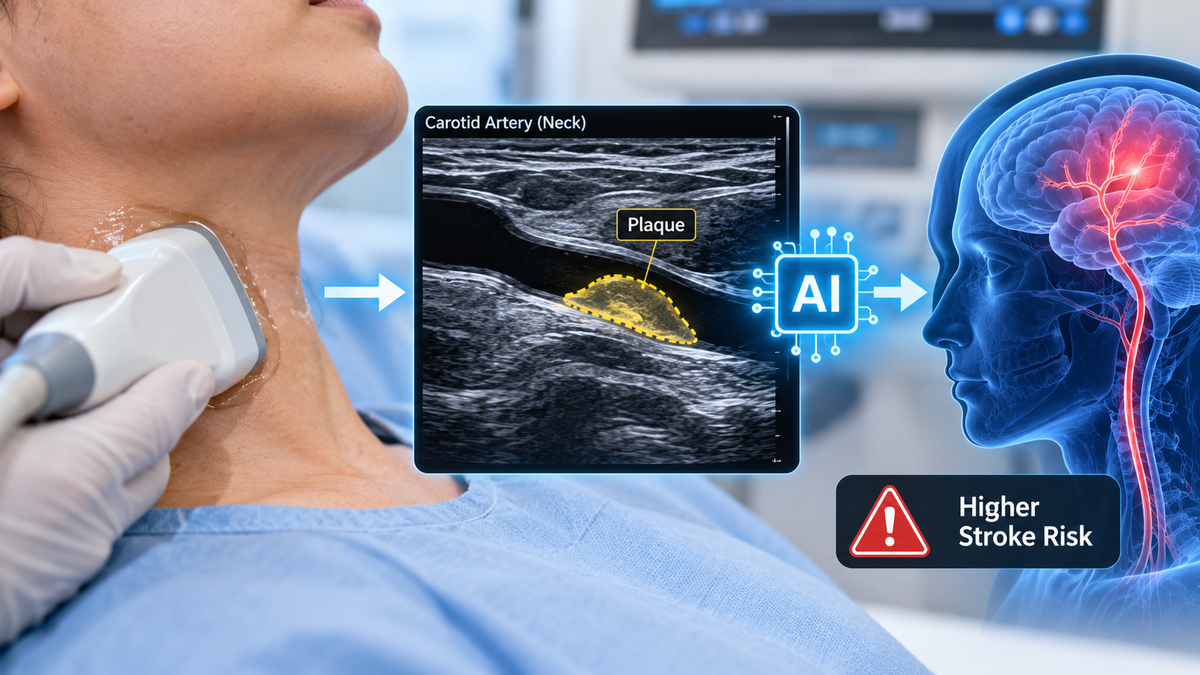
Artificial intelligence may be able to extract useful information about future stroke risk from a routine ultrasound scan of the arteries in the neck, according to a large multicentre study published in npj Digital Medicine.
Researchers developed an AI system to analyse ultrasound images of the carotid arteries. These are the major arteries in the neck that carry blood towards the brain.
The study involved 6,618 people at high cardiovascular risk and more than 38,000 ultrasound images collected at four medical centres.
The AI system was designed to identify plaques inside these arteries and assess features that may suggest whether a plaque is more vulnerable.
Why do carotid plaques matter?
Atherosclerosis causes fatty and inflammatory material to build up inside arteries. When this happens in the carotid arteries, the plaques can contribute to ischemic stroke if material from a plaque or a blood clot blocks blood flow to the brain.
Not every carotid plaque carries the same risk. Doctors therefore consider not only how much an artery has narrowed, but also whether the plaque appears unstable or vulnerable.
Routine B-mode ultrasound can show many plaque features, but interpretation can vary between observers.
What did the AI do?
The researchers trained the system to identify carotid plaques and analyse five visible plaque characteristics on ordinary ultrasound images.
The system then combined this information to classify plaques by vulnerability. In testing, it performed better than six independent clinicians for several image-reading tasks.
Did the AI result relate to actual future events?
Yes. This is one of the most important parts of the study.
Researchers had follow-up information for 2,174 participants. During a median follow-up of 37 months, 277 ischemic cerebrovascular events occurred.
After accounting for conventional clinical risk factors, people classified by the AI as high risk had about twice the subsequent risk of an ischemic cerebrovascular event compared with people not placed in the high-risk group.
Why could this be useful?
The possible advantage is that the technique uses ordinary carotid ultrasound images. It does not require a completely new scanning technology.
Carotid ultrasound is non-invasive and is already available in many hospitals and diagnostic centres. If the AI approach is independently validated, it could help make plaque assessment more consistent and give doctors extra information when estimating stroke-related risk.
Does this mean AI can now predict who will have a stroke?
No. The AI is estimating risk. It is not predicting an individual person's future with certainty.
Many people classified as high risk will not have a stroke, while some people classified at lower risk may still experience one.
Most importantly, this study did not test whether changing treatment because of an AI result prevents strokes. That would require prospective clinical trials.
What still needs to be established?
The system needs validation across different countries, populations, ultrasound machines and healthcare settings.
Researchers also need to determine whether AI-guided decisions, such as changing preventive medication, ordering additional imaging or considering vascular procedures, actually improve patient outcomes.
Evidence so far
Promising multicentre validation, but not yet an outcome-changing clinical trial.
The study included thousands of participants, external validation and several years of follow-up. Those are important strengths. However, clinical trials are still needed to show whether using the AI system to guide care actually prevents stroke or other cerebrovascular events.