
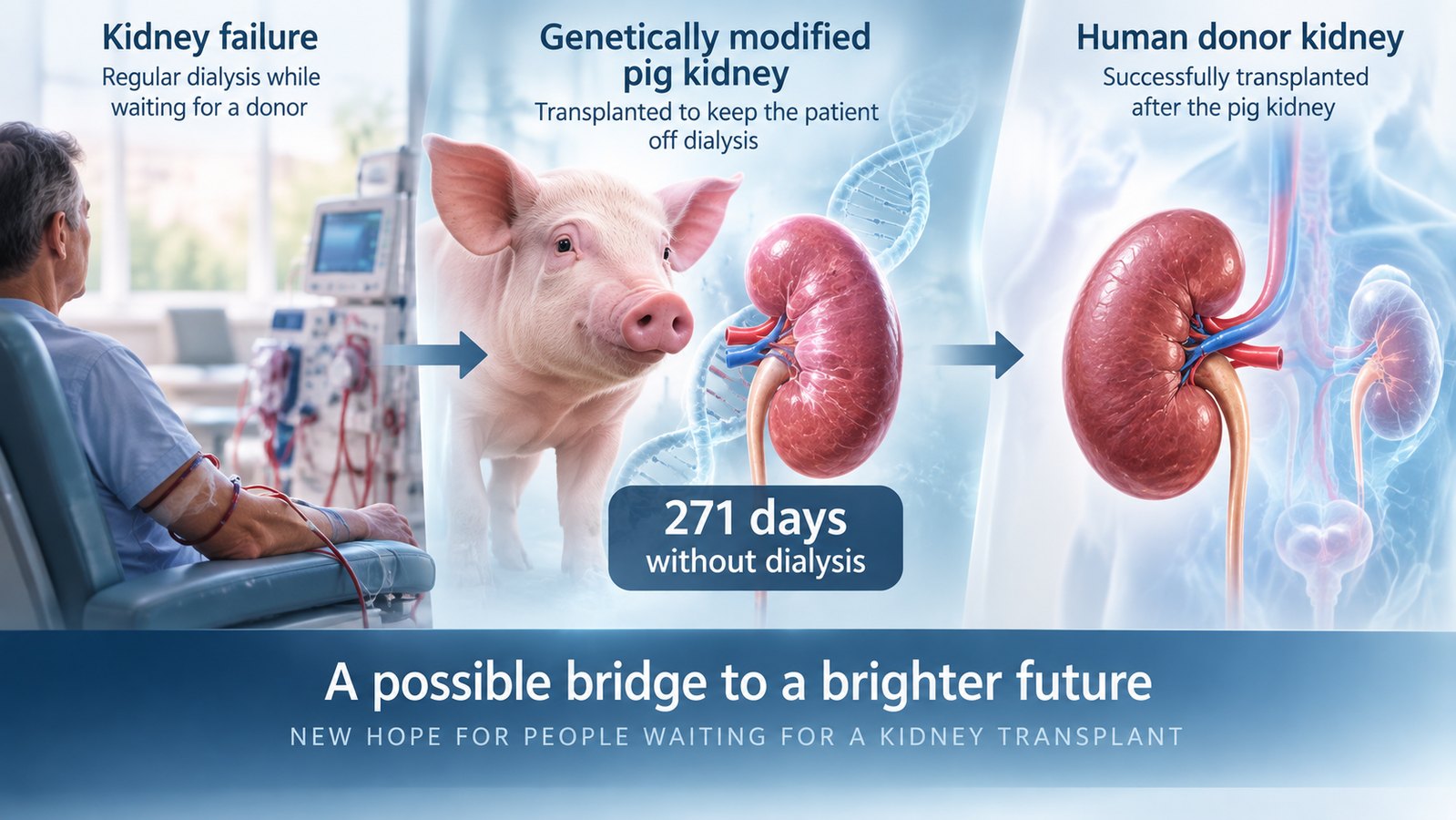
A genetically modified pig kidney kept a man with kidney failure off dialysis for almost nine months before he later received a human donor kidney, according to a report published in The Lancet.
The case represents the longest period reported so far that a living recipient of a pig kidney has remained free from dialysis, and the first documented transition from a pig kidney transplant to a later human kidney transplant.
The result does not mean pig kidneys are ready to replace human kidney transplantation. It is a report involving one carefully selected patient. But it suggests that animal organs might eventually have another important role: acting as a temporary bridge while a patient waits for a suitable human donor.
Why are scientists testing pig kidneys?
People with end-stage kidney disease need either regular dialysis or a kidney transplant to stay alive.
A kidney transplant can provide much better quality of life for many patients, but there are far fewer donated kidneys than people who need them. Some patients therefore remain on dialysis for years while waiting for a donor.
Researchers have been exploring whether organs from specially bred and genetically modified pigs could help reduce this shortage.
Pig organs are roughly comparable in size to human organs, but an ordinary pig kidney would be rapidly attacked by the human immune system. Modern gene-editing techniques can alter some of the pig genes responsible for this rejection and address other biological concerns.
Transplanting an organ from one species into another is known as xenotransplantation.
What happened in this patient?
The patient had end-stage kidney disease and faced a long wait for a human donor kidney.
Doctors transplanted a genetically modified pig kidney.
The kidney functioned sufficiently well for the patient to live 271 days without dialysis.
There were problems during that period, including an episode of immune rejection that could initially be treated.
Eventually the pig kidney developed inflammation and damage to its small blood vessels and stopped functioning adequately. It was removed, and the patient temporarily returned to dialysis.
He subsequently received a kidney from a deceased human donor.
Importantly, the earlier exposure to the pig kidney did not appear to prevent the human transplant from working successfully.
Why is that important?
Until now, most attention around pig-to-human kidney transplantation has focused on whether the animal organ can survive safely inside a human body.
This case raises another possibility.
Instead of necessarily expecting a pig kidney to last for the rest of a patient's life, a xenotransplant might eventually help some patients avoid or reduce time on dialysis while they wait for a human kidney.
That could be important because long periods of dialysis can be physically demanding and are associated with significant health complications.
Researchers also reported no evidence that pig pathogens were transmitted to the patient during the xenotransplant period.
Does this mean pig kidney transplantation is now established treatment?
No.
This is a single first-in-human experience.
One successful case cannot tell doctors how often pig kidneys will work, how long they will last, which patients are most suitable, or how serious the risks may be when the procedure is performed in larger numbers.
The pig kidney ultimately failed because of inflammatory and small-blood-vessel injury.
Patients receiving xenotransplants also require powerful medicines to suppress the immune system, which themselves carry important risks.
What happens next?
The next major step is carefully controlled clinical testing involving more patients.
Researchers need to determine how to reduce rejection and blood-vessel injury, how best to modify donor pigs, and which immune-suppressing treatment gives the best balance between protecting the transplanted kidney and protecting the patient.
The current case therefore should not be interpreted as the arrival of routine pig-to-human transplantation.
But it provides important evidence that a genetically modified pig kidney can function for many months and, at least in one patient, can serve as a temporary bridge before successful human transplantation.
Evidence so far
Promising breakthrough, but extremely early evidence.
The report is peer reviewed and provides unusually detailed information from a real living recipient.
However, it involves one patient. Larger clinical trials are needed before doctors can know whether the approach is sufficiently safe, durable and reliable for wider use.