Sanfilippo syndrome type A is a rare inherited disease that gradually damages the brain and nervous system, causing children to lose developmental abilities over time.
Until now, treatment has largely focused on managing symptoms and complications rather than correcting the underlying biological defect.
That has changed with the US Food and Drug Administration's approval of rebisufligene etisparvovec-hopf, marketed as Fayuvi, for the neurologic manifestations of mucopolysaccharidosis type IIIA, better known as Sanfilippo syndrome type A, in pediatric patients with preserved neurodevelopmental function.
The therapy was approved on 17 September 2026.
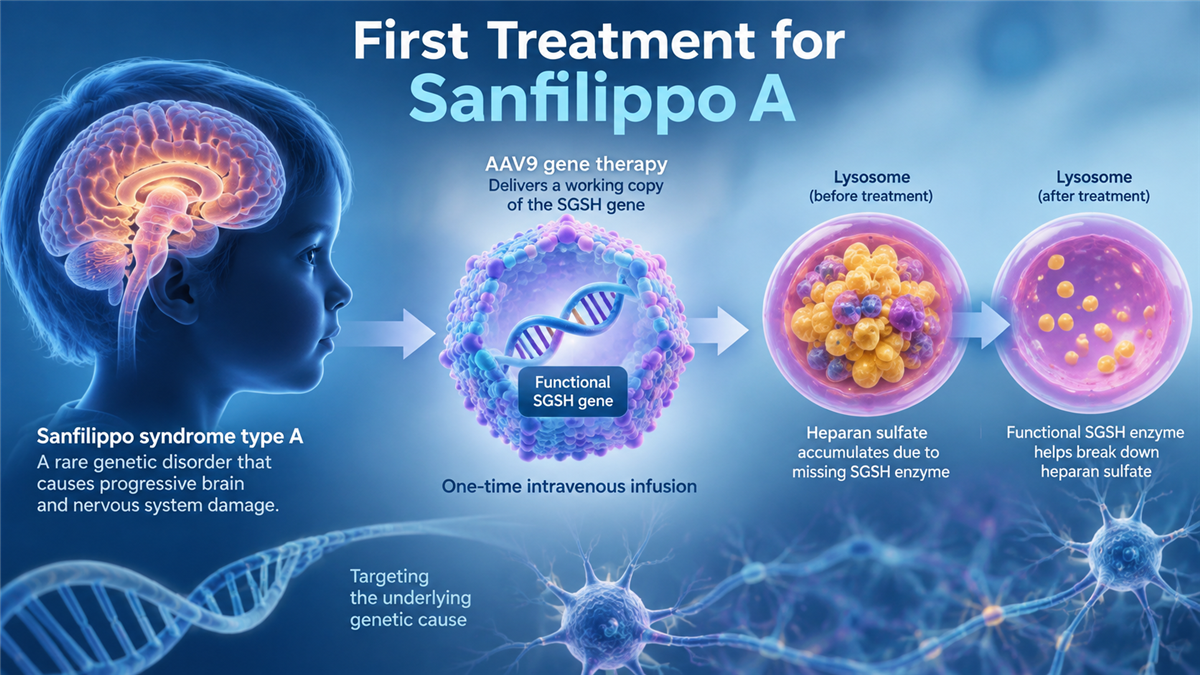
It is administered as a single intravenous infusion and uses an adeno-associated virus type 9, or AAV9, vector to deliver a functioning copy of the SGSH gene.
The approval makes it the first FDA-approved treatment for Sanfilippo syndrome type A.
That is an important milestone for a devastating childhood disease, but the evidence needs to be understood carefully. The main efficacy comparison did not come from a conventional randomized placebo-controlled trial.
What is Sanfilippo syndrome type A?
Sanfilippo syndrome belongs to a group of inherited conditions called lysosomal storage disorders.
Cells contain structures called lysosomes that help break down and recycle substances.
Children with Sanfilippo syndrome type A have harmful variants in the SGSH gene. This results in deficiency of an enzyme called N-sulfoglucosamine sulfohydrolase, which is needed to break down a complex sugar molecule called heparan sulfate.
Without enough of this enzyme, heparan sulfate progressively accumulates inside cells.
The nervous system is particularly affected.
Children may initially appear to develop relatively normally but can later develop speech and learning difficulties, behavioural changes, sleep problems and progressive loss of cognitive and motor abilities.
Because the disease continues to progress, preventing or slowing neurological damage early in life is an important treatment goal.
How does the gene therapy work?
Rebisufligene etisparvovec uses an AAV9 vector as a delivery system.
The vector carries a functioning copy of the human SGSH gene.
After the treatment is given intravenously, the aim is for cells to begin producing functional SGSH enzyme, helping the body break down accumulated heparan sulfate more effectively.
This is fundamentally different from treating individual symptoms.
The treatment attempts to address the underlying enzyme deficiency caused by the genetic disease.
However, this does not mean that the treatment can necessarily reverse neurological damage that has already occurred.
What evidence supported the approval?
Because Sanfilippo syndrome type A is extremely rare and relentlessly progressive, studying new treatments through large conventional randomized trials is difficult.
The pivotal efficacy analysis therefore compared children who received gene therapy with children from an external natural-history cohort — a group used to show how the disease typically progresses without the experimental treatment.
The main comparison included 17 treated children and 27 untreated children in the natural-history group.
Between 24 and 60 months of age, children treated with the gene therapy had cognitive raw scores that were, on average, 23.5 points higher than those of the natural-history comparison group.
Parts of the clinical development programme now include follow-up extending for several years, allowing researchers to continue monitoring durability and longer-term safety.
These results supported the conclusion that treatment can preserve neurodevelopmental function better than would be expected from the natural course of the disease in appropriately selected children.
Why does the natural-history comparison matter?
This is an important limitation.
A randomized controlled trial usually assigns participants to different treatments by chance, helping reduce differences between the groups that could influence the outcome.
That was not the design used for the key efficacy comparison here.
Instead, treated children were compared with previously characterized untreated children.
Natural-history controls can be especially useful in very rare and severe diseases, where conventional trials may be difficult or ethically complicated.
But they also create more uncertainty than a well-conducted randomized comparison.
Differences between treated children and historical or external controls may not be entirely attributable to treatment.
For that reason, the approval should not be interpreted as proof that the therapy completely stops Sanfilippo syndrome or restores neurological abilities already lost.
Is this a cure?
The approval represents a major therapeutic advance, but describing it as a cure would go beyond the evidence.
The available evidence supports better preservation of neurodevelopmental function compared with the natural-history group.
It does not establish that every treated child will respond similarly.
It also does not establish that the treatment:
- completely stops progression throughout life;
- restores neurological function already lost;
- prevents every complication of Sanfilippo syndrome;
- or normalizes life expectancy.
Long-term follow-up remains particularly important for a treatment designed to be given only once.
What are the important risks?
Gene therapies can carry risks that are different from those of conventional medicines.
Important safety concerns associated with rebisufligene etisparvovec include liver toxicity, changes in platelet counts including thrombocytopenia, thrombotic microangiopathy and hypersensitivity or infusion-related reactions.
Long-term monitoring is also important because gene therapies using viral vectors can carry theoretical or observed risks that may emerge over extended follow-up, including concerns about malignancy.
Treatment therefore requires specialist assessment, preparation and monitoring.
The fact that the therapy is given once does not mean medical follow-up ends after the infusion.
Why is this approval important?
For families affected by Sanfilippo syndrome type A, the major problem has been the absence of a treatment capable of addressing the underlying genetic and enzyme defect.
Supportive care remains important, but it cannot correct the missing SGSH activity.
Gene replacement offers a fundamentally different approach.
The approval also illustrates a broader change occurring in rare inherited diseases: treatments are increasingly being designed around the specific molecular defect responsible for disease rather than only treating its consequences.
For Sanfilippo syndrome type A, this is the first time that approach has produced an FDA-approved therapy.
What happens next?
Long-term follow-up will be essential.
Researchers and regulators will need to understand:
- how durable the neurodevelopmental benefit remains;
- whether treatment changes other neurological and systemic complications;
- how outcomes vary according to age and disease stage at treatment;
- the long-term safety of the AAV9 gene therapy;
- and whether additional risks become apparent as larger numbers of children receive treatment.
Earlier diagnosis may also become increasingly important if treatment works best before substantial neurological damage develops.
For now, the most accurate interpretation is that Sanfilippo syndrome type A has its first approved treatment, with evidence that a one-time gene therapy can preserve neurodevelopmental function better than the untreated natural history of the disease in selected children.
It is a major advance — but not evidence that the disease has been cured.