An experimental immune treatment that can be manufactured in advance rather than individually engineered for each patient has produced encouraging early results in people with active systemic lupus erythematosus.
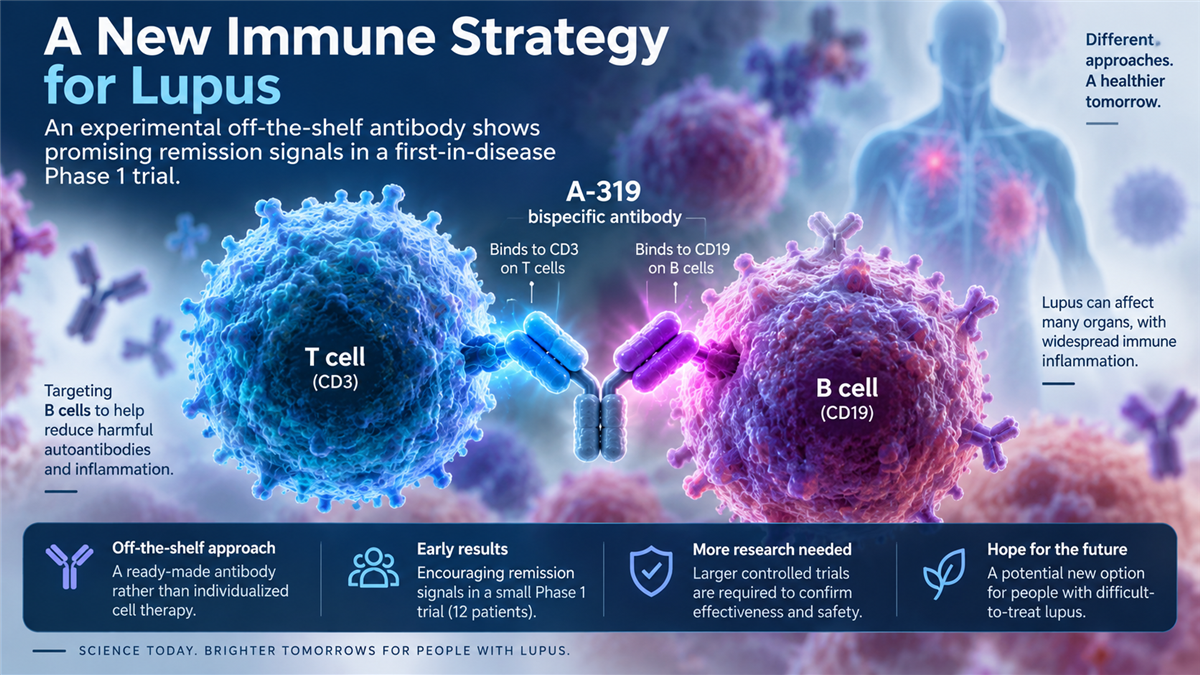
The treatment, called A-319, is a CD3×CD19 bispecific T-cell engager.
It is designed to redirect the patient's own T cells toward B cells and produce very deep B-cell depletion.
Researchers are interested in this approach because small studies of CAR-T cell therapy have produced striking remission results in severe autoimmune disease.
But CAR-T treatment is highly complex.
It usually requires collecting a patient's own T cells, genetically modifying them in a laboratory, expanding them, giving chemotherapy to prepare the patient and then reinfusing the engineered cells.
A bispecific antibody such as A-319 could potentially produce some of the same biological effects using an off-the-shelf medicine.
The new results are promising, but they come from only 12 patients in a Phase 1 trial.
That means they should be viewed as an early signal rather than proof of a new established lupus treatment.
What is systemic lupus erythematosus?
Systemic lupus erythematosus, usually called lupus or SLE, is an autoimmune disease.
In autoimmune disease, the immune system mistakenly attacks the body's own tissues.
Lupus can affect many organs, including:
- joints;
- skin;
- kidneys;
- blood cells;
- lungs;
- nervous system;
- blood vessels.
B cells play a central role in lupus.
They can develop into cells that produce autoantibodies — antibodies directed against the body's own structures.
These autoantibodies and other abnormal immune signals contribute to inflammation and tissue damage.
This makes B cells an important treatment target.
Why are researchers trying deeper B-cell depletion?
Several established lupus medicines reduce or modify B-cell activity.
But researchers have become interested in whether a much deeper temporary removal of abnormal B-cell populations could allow the immune system to rebuild itself in a healthier form.
That idea gained attention after small CAR-T studies reported prolonged drug-free remissions in patients with severe autoimmune disease.
The biological concept is sometimes described as an immune reset, although that term should be used cautiously because the immune system is not literally erased and rebuilt from zero.
The challenge is that CAR-T treatment is difficult to deliver.
It generally requires:
- individualized cell collection;
- genetic engineering;
- specialized manufacturing;
- lymphodepleting chemotherapy;
- highly specialized treatment centres.
Researchers therefore want to know whether a drug that recruits the patient's existing T cells could produce deep B-cell depletion without individualized CAR-T manufacturing.
What is A-319?
A-319 is a bispecific T-cell engager.
“Bispecific” means the antibody can bind two different targets.
One side recognizes CD3, a molecule found on T cells.
The other recognizes CD19, found on B cells.
By binding both at the same time, A-319 brings T cells into close contact with B cells.
The activated T cell can then destroy the targeted B cell.
The aim is to produce profound B-cell depletion using a medicine that can be manufactured ahead of time.
How was the trial performed?
The study published in Nature Medicine reported the intravenous-treatment arm of an ongoing first-in-disease Phase 1 trial.
It included 12 patients with active systemic lupus erythematosus.
Participants were followed for 52 weeks.
They received priming doses followed by A-319 treatment three times weekly for three weeks.
The primary purpose of a Phase 1 study is usually to assess safety and tolerability, not to prove that a treatment works.
Researchers also examined:
- how the drug behaved in the body;
- the depth of B-cell depletion;
- immune-system changes;
- exploratory measures of lupus activity and remission.
What happened to the B cells?
A-319 produced dose-dependent B-cell depletion.
At the higher doses, researchers observed complete depletion of circulating peripheral B cells.
This provides evidence that the drug was achieving its intended biological effect.
Detailed immune analysis also suggested broad changes across several immune-cell populations after treatment.
Researchers reported that some of these changes resembled those observed after CD19 CAR-T treatment in lupus.
However, biological similarity does not mean the two treatments have been proven equally effective.
What happened to lupus disease activity?
Of the patients who could be assessed for exploratory efficacy outcomes:
8 of 10, or 80%, reached Lupus Low Disease Activity State at 12 months.
6 of 10, or 60%, met the study's remission definition at 12 months.
Researchers also reported sustained reductions in:
- lupus disease-activity scores;
- autoantibody levels;
- protein in the urine.
These findings are encouraging.
But they were exploratory outcomes in a very small Phase 1 study without a randomized control group.
They cannot establish that A-319 caused durable remission in the broader lupus population.
Was the treatment safe?
The primary endpoint of the study was safety and tolerability.
The researchers reported:
- no treatment-related serious adverse events;
- no deaths;
- no grade 3 or higher cytokine release syndrome;
- no neurotoxicity.
Cytokine release syndrome, or CRS, occurred in 11 of the 12 patients, but it was predominantly grade 1.
CRS results from rapid immune activation and can cause symptoms such as fever and systemic inflammation.
Although the early safety findings are encouraging, a 12-patient study cannot reliably detect uncommon but serious complications.
Larger studies will be essential.
How is this different from CAR-T therapy?
CAR-T therapy involves taking T cells from a patient or donor and genetically engineering them to recognize a target such as CD19.
A-319 instead uses the patient's existing T cells.
The antibody physically links those T cells to CD19-positive B cells.
That could potentially offer several practical advantages:
- no individualized cell manufacture;
- potentially faster access;
- easier repeat dosing;
- broader availability if effectiveness is proven.
But the two technologies are not identical, and it is far too early to say that A-319 can replace CAR-T therapy.
Why could an off-the-shelf approach matter?
CAR-T therapy requires highly specialized facilities and complex manufacturing.
That severely limits access.
If a conventionally manufactured medicine could achieve deep B-cell depletion with acceptable safety and durable clinical benefit, it could potentially make this treatment concept available to many more patients.
It might also be easier to study across larger populations and different autoimmune diseases.
That is why the concept is important even though the current lupus study is tiny.
Has lupus now been cured with an antibody?
No.
The study does not support that conclusion.
Only 12 people were treated.
There was no randomized control group.
Clinical response and remission assessments were exploratory.
Phase 1 trials are designed primarily to establish whether a treatment can be given safely enough to justify further study.
The results therefore show:
- biological activity;
- profound B-cell depletion;
- encouraging clinical signals;
- an acceptable early safety profile in this very small cohort.
They do not prove that A-319 is an established treatment or that it produces durable remission for most people with lupus.
What happens next?
The findings justify larger controlled clinical trials.
Researchers will need to determine:
- whether remission rates remain high in larger populations;
- how long responses last;
- whether lupus returns when B cells recover;
- which patients benefit most;
- how infection risk changes after profound B-cell depletion;
- whether repeated treatment is required;
- whether A-319 is safer or more practical than other deep B-cell-depletion strategies.
Only controlled studies can determine where this approach may eventually fit into lupus treatment.
Current evidence
First-in-disease Phase 1 evidence showing profound B-cell depletion, encouraging remission signals and an acceptable early safety profile in 12 patients.
A-319 should be described as an experimental treatment requiring larger controlled trials.
It is not an established lupus therapy and should not be presented as a proven substitute for CAR-T treatment.
---