
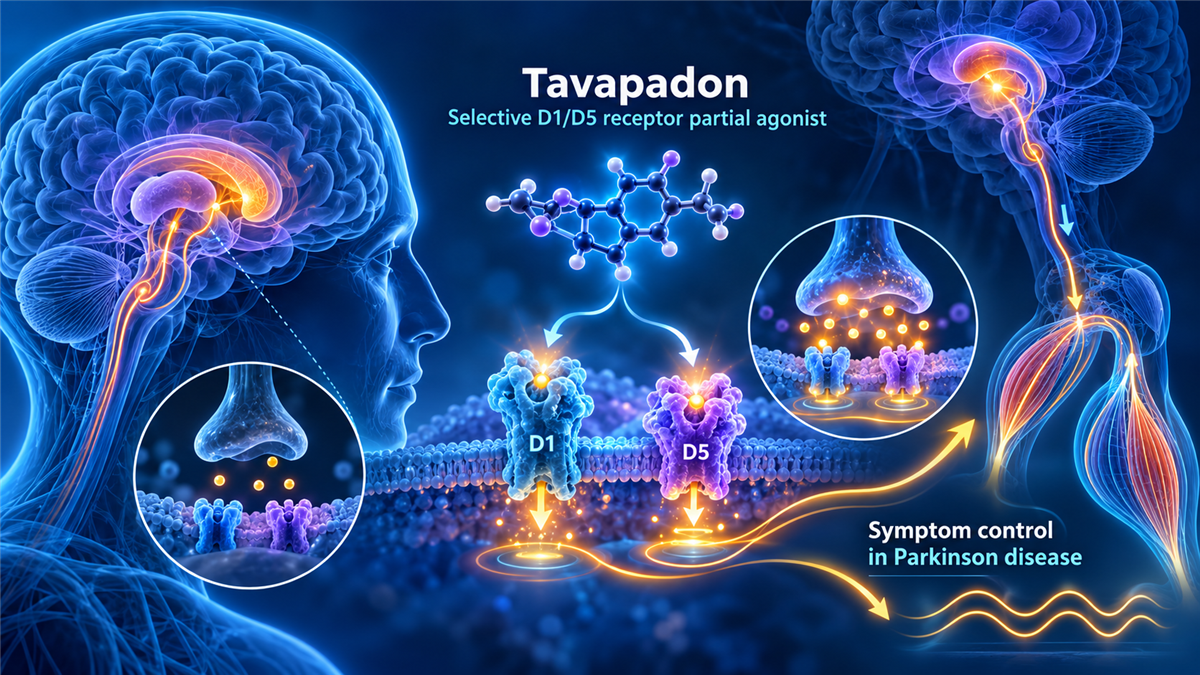
The US Food and Drug Administration has approved Juvmo (tavapadon) for the treatment of Parkinson disease in adults. The once-daily tablet may be used without levodopa in earlier disease or alongside levodopa when motor fluctuations develop.
Parkinson disease gradually damages dopamine-producing nerve cells. Falling dopamine signalling contributes to slowness, stiffness, tremor and difficulty with balance and everyday movement.
Tavapadon is a selective partial agonist at D1 and D5 dopamine receptors. Most older dopamine agonists primarily act through D2 and D3 receptors, so tavapadon offers a different way of stimulating dopamine pathways involved in movement.
The approval was supported by the Phase 3 TEMPO programme. In people with early Parkinson disease, tavapadon improved measures of motor function and activities of daily living compared with placebo. In TEMPO-3, adding tavapadon to levodopa increased daily “on” time without troublesome involuntary movements and reduced “off” time, when symptoms return as medication effect fades.
Important risks remain. Reported effects include nausea, headache, dizziness, fatigue, changes in taste, vomiting and dry mouth. Dopamine-related risks can include low blood pressure on standing, hallucinations, involuntary movements and unusual compulsive urges. Treatment and dose changes require medical supervision.
Tavapadon is a symptomatic treatment. It may improve movement and daily functioning, but there is no evidence that it stops neurodegeneration, regenerates dopamine-producing neurons or cures Parkinson disease.
Its main significance is the availability of another mechanism and once-daily option that clinicians can tailor to a patient's stage, symptoms and use of levodopa.